

Spending 40+ hours on a document that a bank manager will skim for exactly 120 seconds is a waste of your most valuable resource. 😰 Most founders treat the business plan for first-time entrepreneurs like a high school thesis, drowning in “the old way” of manual research and complex financial jargon. It’s frustrating to stare at a blank page when you’d rather be building your product. You’re right to feel that the traditional, manual template is outdated and inefficient for the 2026 fiscal year.
We agree that the paperwork shouldn’t be the hardest part of starting a company. This guide shows you how to flip the script and build a professional, investor-ready business plan in under 15 minutes. Using modern AI tools and proven strategy frameworks, you’ll gain total clarity on your model without the stress. We’ll walk through the automated steps to secure bank funding and impress investors while saving 90% of the usual drafting time. ✨
Key Takeaways
- Understand why a dynamic roadmap makes you 2.5x more likely to launch successfully compared to starting without a clear strategy.
- Learn to build a high-impact business plan for first-time entrepreneurs by focusing on data-driven scalability rather than outdated 40-page documents.
- Ditch the “Old Way” of manual writing and discover how modern AI tools can cut your planning time from weeks to just 15 minutes.
- Master a proven 5-step strategy to anchor your vision with a powerful value proposition and rapid market insights.
- Unlock the secret to generating a 72-section, investor-ready plan ✨ that guarantees professional quality without the high cost of traditional consultants.
Why Your First Business Plan is the Difference Between Success and a Costly Lesson
Don’t mistake a business plan for a dusty document gathering cobwebs in a bank vault. In 2026, a business plan for first-time entrepreneurs is a high-speed GPS for your venture. It’s the difference between launching with confidence and burning through your life savings on a “hunch.” Statistics from the Journal of Business Venturing show that entrepreneurs who complete a formal plan are 2.5x more likely to actually start their business compared to those who wing it. Planning isn’t just about paperwork. It’s about survival.
This document forces you to find the “cracks” in your idea before you spend a single dollar. If your profit margins don’t work on a spreadsheet, they certainly won’t work in the real world. Before you dive into the details, it’s helpful to understand the foundational elements of what is a business plan to ensure you aren’t missing critical components. Modern lenders and investors in 2026 now utilize automated risk assessment tools. These systems scan your plan for structured data and real-time market projections. Vague promises won’t cut it anymore; you need concrete numbers.
The 3 Core Purposes of a Modern Plan
- Strategic Clarity: You must define exactly what you are selling and who your primary customer is. If you try to sell to everyone, you’ll end up selling to no one.
- Financial Feasibility: This is your reality check. You need to prove the numbers work before you quit your day job. A solid plan tracks your burn rate and identifies your break-even point.
- Fundraising: Whether you want a $25,000 bank loan or a $2 million seed round, you must speak the language of capital. Investors want to see a clear path to a return on their investment.
Common Pitfalls for First-Time Founders
Many founders fall victim to “Blank Page Syndrome.” They stare at a flashing cursor for weeks, overwhelmed by the 40+ sections required in a traditional layout. This leads to the second trap: over-researching. You can get stuck in “analysis paralysis” for months while your competitors move into the market. Don’t let the quest for perfection stop your launch. Finally, never assume your idea is 100% unique. Ignoring the competition is a fast way to get blindsided. A professional business plan for first-time entrepreneurs must acknowledge rivals and explain why your solution is the smarter choice.
Stop guessing. Start building. A well-structured plan turns your vision into a professional roadmap that banks and investors actually respect. ✨
The Anatomy of a High-Impact Business Plan in 2026
Forget the 40-page binder gathering dust on a shelf. In 2026, a high-impact business plan for first-time entrepreneurs is lean, data-driven, and focused on execution. Investors and banks now prefer 15-20 pages of high-density value over fluff. They want to see how you scale, not how many adjectives you can use. If your plan looks like a novel, it’s already outdated. Modern plans focus on agility and real-time market insights that reflect the current economic climate.
While the SBA guide to writing a business plan provides a solid foundation for traditional requirements, your 2026 version must go further. It needs to prove your model works with hard data, not just gut feelings. Scalability is the goal. You need to demonstrate that your business can grow without your overhead costs spiraling out of control.
Must-Have Sections for Every Startup
Executive Summary: The “elevator pitch” in written form. This is your most important 500 words. It’s the first thing people read but the last thing you should write. By waiting until the end, you ensure every claim matches the detailed data in the following pages. If this section doesn’t grab attention in 30 seconds, the rest of the plan won’t be read. Keep it punchy and results-oriented.
Market Analysis: Who is your customer and why do they need you now? Don’t just say everyone is your customer. In 2026, niche targeting is the only way to survive. Identify your first 1,000 users and explain the specific pain point you’re solving today. Use current demographic data to back up your claims.
Operational Plan: How the business actually functions on a Tuesday morning. Avoid vague strategies. Describe the daily workflow. Who handles the orders? What software manages the inventory? This section proves you can actually run the company once the funding arrives.
The Financial Suite
Financial projections must be realistic. Avoid the “hockey stick” growth curves that assume 500% growth without a marketing budget. Your numbers should reflect a deep understanding of your industry’s benchmarks.
- Cash Flow Statement: This is the lifeblood of your first 12 months. It tracks exactly when money enters and leaves your bank account. Without it, you’re flying blind.
- Break-even Analysis: This tells you the exact date you stop losing money and start making it. It’s the most critical number for your survival and the one investors look for first.
For a deeper dive into these numbers, check out our cash flow analysis guide. If building these complex spreadsheets feels overwhelming, you can generate a professional business plan for first-time entrepreneurs instantly and skip the manual math.
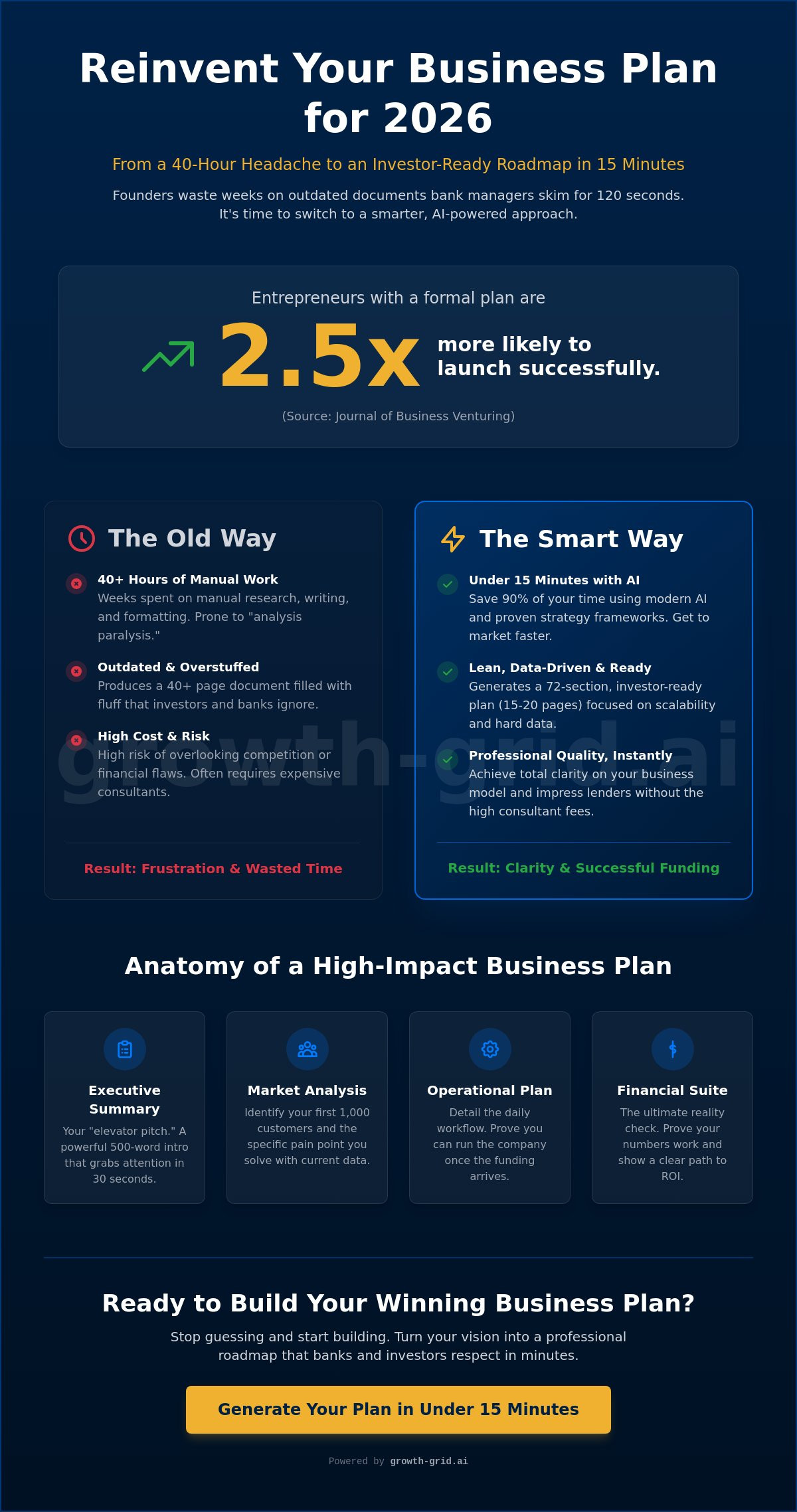
The Old Way vs. The Smart Way: Why Manual Writing is Obsolete
Writing a business plan for first-time entrepreneurs used to be a grueling rite of passage. You would spend 40 to 100 hours staring at a blinking cursor, wondering if your market research was actually relevant. Why pay a consultant $2,000 for a document that modern software generates for $19? In 2026, manual writing isn’t just slow; it’s a massive waste of your most valuable resource: time. You need a plan that works, and you need it now.
The Traditional Method (The Old Way)
The traditional approach is defined by high stress and a high risk of human error. Most founders start by searching for a Business Plan Template for a Startup Business to get their bearings. While these templates provide a helpful structure, filling them out manually often leads to a “cookie-cutter” result that fails to impress investors. You end up cross-referencing 72 different sections manually; it is a recipe for inconsistency. Static financial spreadsheets and outdated market data from three years ago won’t help you secure funding in today’s fast-moving economy.
- ✗ 40-100 hours of manual labor and research.
- ✗ High consultant fees averaging $2,000 or more.
- ✗ Static data that becomes obsolete the moment you hit “Save.”
- ✗ Inconsistent formatting and “copy-paste” errors.
The AI Revolution (The Smart Way) ✨
The smart way leverages technology to handle the heavy lifting. AI-powered platforms like GrowthGrid use the GPT-4 model to tailor every section to your specific niche. This is how a business plan for first-time entrepreneurs should be built; through guided questionnaires that extract your vision without the confusing jargon. Instead of weeks of work, you get instant generation of professional, bank-ready PDFs and DOCs in under 15 minutes. You get bank-level encryption to protect your ideas and 24/7 support to ensure you never feel stuck.
- ✓ Completed professional plan in under 15 minutes.
- ✓ Affordable flat fee of $19.
- ✓ Real-time data and niche-specific customization using GPT-4.
- ✓ Professional quality designed to meet bank and investor standards.
Stop stressing over margins and formatting. Your job is to lead your company, not to act as a full-time technical writer. Choose the path that lets you launch faster. Generate ✨
From Idea to Investor-Ready: A 5-Step Execution Strategy
Stop overthinking. Most founders fail because they get stuck in the planning phase for months. You can build a professional business plan for first-time entrepreneurs in hours, not weeks, by following this high-speed execution framework. Speed is your greatest advantage in 2026.
- Step 1: Define your “One Sentence Value Proposition.” Anchor your entire plan with a single sentence: “We help [Target Audience] achieve [Result] through [Unique Mechanism].” If you can’t explain it in 15 words, you don’t understand it yet.
- Step 2: Conduct rapid market research. Use AI tools to scan 2026 search trends and social sentiment. Don’t guess what people want; look at the data.
- Step 3: Build your financial foundation. Map out your projections for years one through three. Investors look for realistic growth, not “hockey stick” graphs with no data to back them up.
- Step 4: Generate your plan. Use an AI business plan generator to handle the heavy lifting. This turns your raw ideas into a structured, 40+ page document instantly.
- Step 5: Review and Refine. AI provides the bulk, but you provide the soul. Check the tone and ensure your unique founder story shines through.
Validating Your Market Quickly
Don’t wait for a product launch to see if people care. Use TikTok Creative Center and Google Trends to see what’s trending right now. Find your top three competitors and read their 1-star reviews. These “weak spots” are your entry points. Write down your target audience with precision. For example: “Our primary market is freelance graphic designers aged 25 to 34 who spend over $200 monthly on software subscriptions.” Specificity wins every time.
Getting Your Financials Right
Be brutally honest about your startup costs. Include everything from $500 LLC filing fees to $3,500 for initial equipment. Calculate your monthly “burn rate” immediately. If you have $25,000 in savings and spend $2,500 a month, you have exactly 10 months to become profitable. You can find more detailed budgeting frameworks in our startup business plan guide to ensure you don’t miss hidden costs.
The old way of writing a business plan for first-time entrepreneurs takes 40+ hours of frustration. The smart way takes 8 minutes. ✨
GrowthGrid: Generate Your Professional Business Plan ✨ in Under 15 Minutes
Writing a business plan for first-time entrepreneurs shouldn’t feel like a second job. Most founders spend 40 hours or more staring at a blinking cursor. They worry about formatting, financial formulas, and market data. GrowthGrid eliminates that stress. You focus on your vision while we handle the structure. Traditional planning is slow. It’s expensive. It’s frustrating. We’ve replaced that outdated process with a streamlined system that delivers results in minutes, not weeks.
Our platform generates a 40+ page document with 72 distinct sections. It’s tailored specifically to your industry, whether you’re opening a local boutique or a global tech startup. You’ll get the same depth and professional polish that high-end consulting firms provide. Those firms often charge between $5,000 and $10,000 for a single document. GrowthGrid provides that same level of quality for just $19. It’s the smart way to launch your venture without draining your startup capital before you even open your doors.
How GrowthGrid Works for Beginners
You don’t need an MBA to get started. The process is simple and direct. You’ll answer a series of straightforward questions about your goals, your product, and your target audience. There’s no complex jargon to navigate. Our GPT-4 powered engine takes your unique ideas and builds a complete market analysis, operational strategy, and five-year financial forecast. This is the most efficient way to secure a professional business plan for first-time entrepreneurs without the headache of manual data entry.
The engine analyzes current market trends for 2026 to ensure your strategy is relevant. Once the AI finishes its work, you can download your plan instantly. You’ll receive a professional PDF and a fully editable DOC file. These documents are ready to show to investors, partners, or bank loan officers immediately. You save 90% on traditional costs and 100% of the usual frustration. It’s fast, it’s easy, and it works.
The GrowthGrid Guarantee
We’re confident in the quality of our AI-driven results. That’s why we offer a 100% Satisfaction Guarantee. You’ll love your plan or you get your money back. We’ve removed the risk so you can focus on what matters: building your business. You get a document that meets bank standards and investor expectations for a fraction of the usual cost. Stop overthinking the process and start making progress. Your professional future is just a few clicks away.
Turn Your 2026 Vision Into Reality Today
Starting a venture in 2026 requires more than just a rough idea; it demands a data-driven strategy. You’ve seen why manual writing is now a 40 hour liability that often leads to costly mistakes. A high impact business plan for first-time entrepreneurs must be investor ready from day one to stand any chance in today’s fast paced market. Thousands of founders now skip the weeks of unnecessary stress by choosing efficiency over outdated, manual methods.
Don’t get stuck in the Old Way of drafting documents that nobody reads. You can access a professional framework with 72 sections of high quality content right now. It’s 90% cheaper than hiring a traditional consultant, and it’s already trusted by thousands of new business owners globally. You’ve got the 5 step execution strategy; now you just need the smart tool to finish the job.
Generate your professional business plan with AI in 8 minutes ✨
Your future self will thank you for taking this shortcut. Let’s get to work.
Frequently Asked Questions
Do I really need a business plan if I am not looking for a loan?
Yes, you need a plan to reduce your risk of failure. According to 2023 data from the Small Business Administration, 20% of new businesses fail within their first year. A solid business plan for first-time entrepreneurs acts as a roadmap, helping you spot 15 or more potential operational hurdles before they cost you money. It ensures your team stays aligned on your 12 month goals and 3 year vision.
How long should a business plan be for a first-time entrepreneur?
Aim for 15 to 25 pages for a standard plan, or 40+ pages if you’re seeking venture capital. Focus on quality over quantity. A 20 page document covers the 7 essential sections, including your market analysis and financial strategy, without adding fluff. The Smart Way is to keep it lean and actionable so you actually use it every day instead of letting it gather dust. ✨
Can I use an AI to write my business plan for a bank?
Yes, you can use AI to generate a professional draft, but you must review the data for 100% accuracy. Modern tools can build a 72 section plan in under 15 minutes. Banks require specific financial ratios and 3 years of projections. Using AI saves you 40+ hours of manual writing; however, your personal expertise is what proves the business will succeed to a loan officer. ✓
What is the most important part of a business plan?
The Executive Summary is the most critical section because 80% of investors decide whether to keep reading based on these first two pages. It must clearly state your value proposition, target market, and financial needs. Think of it as your 2 minute elevator pitch in written form. If this section doesn’t grab attention immediately, the rest of your 30 page plan won’t matter. ✗
How much does it cost to have a business plan written?
Hiring a traditional consultant typically costs between $2,500 and $25,000 depending on complexity. These experts often take 4 to 6 weeks to deliver a final product. Alternatively, the Smart Way allows you to generate a professional business plan for first-time entrepreneurs for a fraction of that cost. This shift saves you 90% on traditional consulting fees while delivering the same bank-ready quality instantly.
What happens if my business plan changes after I start?
You should update your plan immediately to reflect new market data. Successful startups pivot an average of 2.5 times in their first 3 years. Treat your plan as a living document rather than a static file. When your customer acquisition cost changes or a new competitor enters the 5 mile radius of your shop, adjust your projections to stay realistic and profitable. 😰
How do I calculate my financial projections if I haven’t started selling yet?
Use bottom-up forecasting by calculating your capacity and expected conversion rates. If you have 2,000 website visitors and a 2% conversion rate, you’ll have 40 sales. Research industry benchmarks from sources like IBISWorld to find average profit margins for your specific NAICS code. This data-driven approach replaces guesswork with 95% more accurate estimates based on real market conditions. ✨
Is a one-page business plan enough for a startup?
A one-page plan is excellent for internal testing, but it’s rarely enough for formal growth. It works well for the Lean Canvas model to validate an idea in 30 minutes. However, if you want to hire 5 employees or secure a lease, you’ll need a full 15 to 20 page document. A detailed plan proves you’ve considered the 10 core risks facing your specific industry. ✓