

Why spend $5,000 on a consultant when the most accurate financial models for your startup are currently locked inside an algorithm? You’ve likely felt the paralyzing weight of “blank page” syndrome while trying to map out your company’s future. It’s a common struggle. While you might be considering a SaaS business plan generator to bridge this gap, you’re likely still worried about the accuracy of complex metrics like MRR, churn, and LTV/CAC. You need a professional document that speaks the language of investors, but you don’t have weeks to waste on manual writing or thousands of dollars to spare for outside help.
Customizing your Marketing and Sales section is equally vital. A Product-Led Growth (PLG) model requires a different narrative than an Enterprise Sales motion. AI provides the framework for both, but you must define the specific touchpoints and conversion triggers that define your funnel. For modern startups, this includes monitoring how your brand is perceived by generative models using the ApexGEO AI Visibility Platform. Finally, ensure your executive summary captures the “Big Vision.” AI is excellent at logic, but it can sometimes underplay the revolutionary nature of your technology. Inject your personality here to make the document truly yours.
We provide comprehensive depth that our competitors simply skip. Our AI covers the technical infrastructure and operational risks that venture capitalists actually care about. Because we’ve automated the heavy lifting, you get professional results at a fraction of a consultant’s cost. It’s a pragmatic solution for founders who need to preserve their capital for growth. Whether you’re building a specialized AI-powered experience like BLVG Music Flow or a global enterprise solution, our platform supports SaaS planning for founders worldwide with data-driven accuracy.
The good news is that you can now leverage high-performance AI to transform your vision into a finished document. We’ll show you how to generate a professional, 72-section plan that captures every critical metric in under 15 minutes. This isn’t just a static template; it’s a dynamic financial engine designed to withstand intense investor scrutiny. By the end of this article, you’ll know exactly how to use these modern tools to build accurate financial models and a 70+ page roadmap that positions your business as a future-forward choice for any venture capitalist.
Key Takeaways
- Understand why static templates fail and how AI bridges the gap between simple narratives and complex recurring revenue metrics.
- Leverage a professional SaaS business plan generator to create a comprehensive 72-section, investor-ready document in under 15 minutes.
- Capture essential SaaS metrics like MRR, churn, and LTV/CAC automatically to ensure your financial models are accurate and credible.
- Apply the “human-in-the-loop” strategy to fine-tune your AI-generated draft and pressure-test your growth assumptions against aggressive scenarios.
- Eliminate the high cost of consultants and the stress of manual writing with a 70+ page roadmap that guides your daily strategic decisions.
Why Traditional SaaS Planning Fails and How AI Generators Bridge the Gap
Static templates are the graveyard of great ideas. They treat revenue like a retail transaction, ignoring the compounding nature of subscriptions. This is the “SaaS Trap.” If your business plan doesn’t calculate how your churn rate impacts your terminal value, investors will stop reading on page three. Traditional planning methods focus on linear growth, but SaaS is a machine built on recurring revenue and compounding retention. You need a plan that reflects that complexity without requiring a degree in financial engineering.
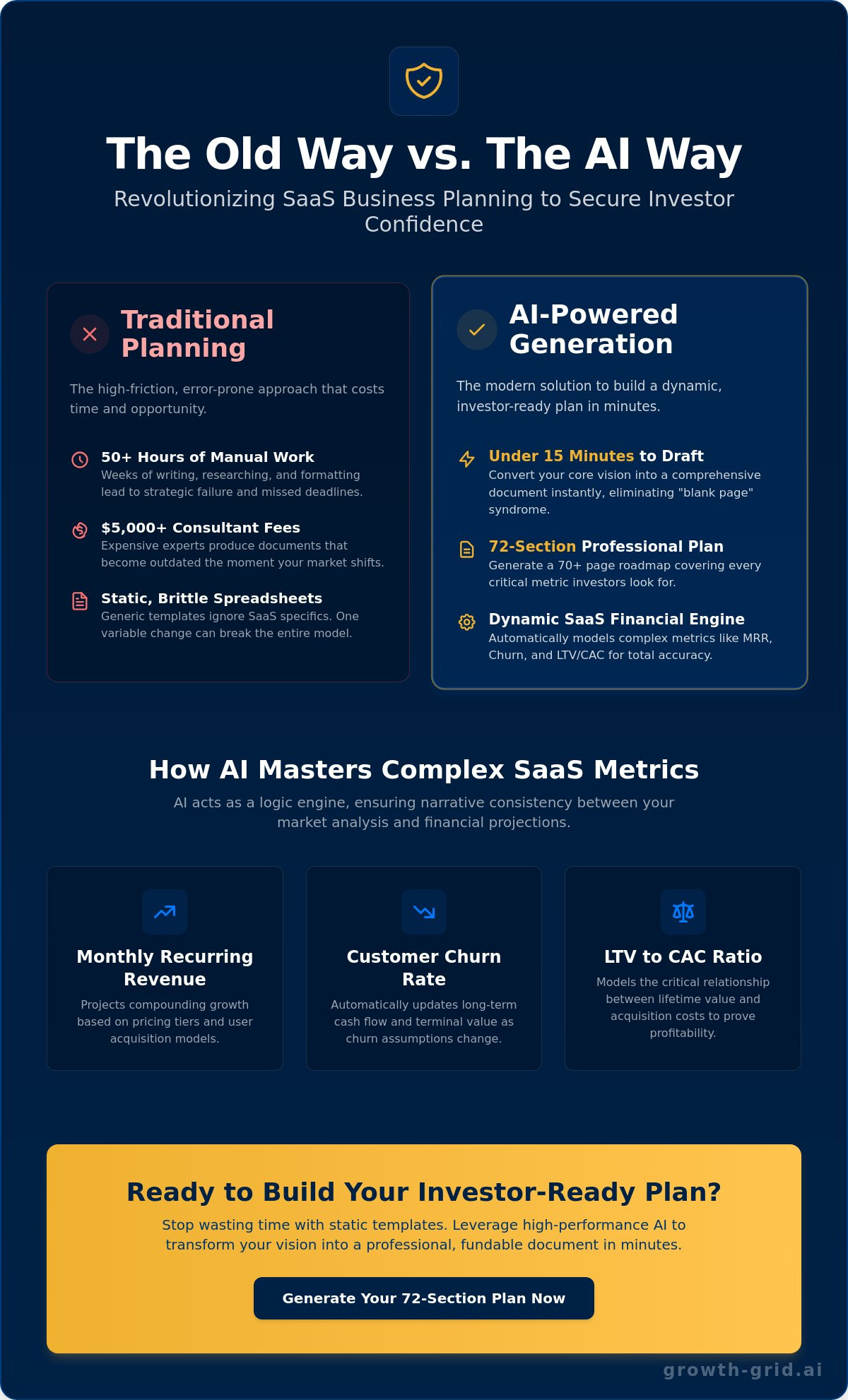
Speed is your only real moat in the early stages of a startup. Spending 40 or 50 hours on a first draft is a strategic failure. A modern SaaS business plan generator solves this by converting your core assumptions into a 70+ page professional document instantly. It eliminates the “blank page” syndrome that keeps most founders stuck in the ideation phase for months. You provide the vision; the AI provides the structure, the logic, and the professional polish required for a serious pitch.
Legacy Planning vs. AI Optimization:
- Legacy: 50+ hours of manual writing and formatting.
- AI: 15 minutes from input to 70+ page document.
- Legacy: Static spreadsheets that break when you change one variable.
- AI: Dynamic financial engines that handle complex SaaS metrics automatically.
- Legacy: Generic templates that ignore recurring revenue dynamics.
- AI: Tailored structures designed specifically for the SaaS business model.
The Cost of Manual Planning in 2026
Manual planning is a massive time-sink. Most founders spend over 50 hours researching and drafting a comprehensive strategy. Beyond the time, there’s the financial weight of hiring a business plan consultant. These experts often charge thousands for documents that become outdated the moment your market shifts. AI allows for real-time adjustments. It keeps your strategy as agile as your code, ensuring you aren’t pitching last month’s assumptions to next month’s investors.
How AI Logic Handles SaaS Metrics
SaaS isn’t just about sales. It’s about the intricate relationship between Churn, CAC, and LTV. A SaaS business plan generator acts as a logic engine that automates these connections. If you change your churn rate assumption, the generator automatically updates your long-term cash flow and valuation. This ensures total narrative consistency across your market analysis and your financial projections. AI is simply better at spotting logical inconsistencies in your business model than a human writer. It catches errors before they become deal-breakers during due diligence.
Step-by-Step: Using an AI Generator to Build Your SaaS Business Plan
Building a professional plan isn’t about writing anymore. It’s about strategic data entry. Using a SaaS business plan generator allows you to focus on the high-level “why” while the software handles the structural “how.” The process moves in four distinct phases. First, you define your core: the specific problem you solve and your unique value proposition. This forms the narrative backbone of your entire document.
Second, you input the “engine.” This is where you define your pricing tiers, MRR targets, and growth assumptions. A robust SaaS financial model requires these inputs to be precise. If you don’t have these figures yet, the generator can provide industry benchmarks to get you started. Third, the AI conducts instant market research. It analyzes competitors and trends to fill in your SWOT analysis. Finally, the system compiles everything into a 72-section comprehensive draft that is ready for review.
Input Preparation: Manual vs. AI-Optimized
- Manual: Guessing market size based on outdated blog posts.
- AI: Real-time data pulls for accurate TAM, SAM, and SOM figures.
- Manual: Struggling to format complex financial tables in Word.
- AI: Automatically generated, investor-ready financial statements.
- Manual: Generic “About Us” sections that lack punch.
- AI: Targeted ICP descriptions that drive your marketing strategy.
Preparing Your Inputs for Maximum Accuracy
Accuracy depends on your “SaaS vitals.” Gather your ARPU and projected churn rates before you begin. You’ll also need your estimated sales cycle length. When describing your tech stack for the Operational Plan, focus on scalability and security. Clearly defining your ideal customer profile (ICP) is non-negotiable. A precise ICP allows the SaaS business plan generator to craft a marketing strategy that actually converts. If you want to see how this looks in practice, you can generate your professional plan now.
Navigating the AI Questionnaire
The questionnaire is your chance to define your “moat.” Why can’t a competitor easily copy your software? Answer these strategic questions with data-driven facts. Specificity leads to 90% less editing later. If you’re unsure about a specific strategy, use the generator to brainstorm options. It acts as a pragmatic partner; it identifies missing pieces in your roadmap and suggests modern alternatives. This interactive process ensures your document isn’t just a template, but a living playbook for your startup’s success.
Evaluating SaaS Business Plan Generators: Critical Features for Founders
Choosing the right tool is the difference between a high-growth roadmap and a generic summary. Most tools fail the “Depth Test” immediately. If a SaaS business plan generator only spits out 10 pages, it isn’t investor-ready. You need 70+ pages of granular detail to prove you’ve thought through every operational hurdle. Serious investors look for a document that covers everything from your go-to-market strategy to your technical infrastructure. A thin plan suggests a thin strategy. Don’t settle for a summary when you need a blueprint.
Your financials must be bulletproof. A professional generator handles complex cash flow analysis and produces full balance sheets automatically. This isn’t just about revenue; it’s about showing how cash moves through your business over time. You also need export flexibility. Ensure the platform offers editable DOC formats for fine-tuning and professional PDF formats for sharing. Think beyond the pitch as well. Does the platform provide AI legal documents for your post-launch operations? A comprehensive solution supports you from the first draft to the first hire.
Standard Tools vs. Professional SaaS Generators:
- Standard: Generic 5-10 page summaries.
- Professional: Comprehensive 70+ page investor-ready documents.
- Standard: Basic revenue tables without churn logic.
- Professional: Deep financial modeling with MRR, Churn, and LTV/CAC.
- Standard: Locked web views or simple text exports.
- Professional: Fully editable DOC and high-fidelity PDF exports.
- Standard: One-off document generation.
- Professional: Integrated support for legal, HR, and strategy documents.
SaaS-Specific Financial Capabilities
Connected financial statements are a hard requirement. If you change a growth assumption, that change must flow through your income statement and cash flow instantly. Built-in SaaS metrics like MRR, Churn, and LTV/CAC ratios are non-negotiable. You need 3-5 year projection capabilities that can withstand the scrutiny of a venture capital presentation. This level of detail shows you understand the “engine” of your business, not just the product.
The Quality of the Narrative Output
Avoid “AI hallucinations” by using platforms grounded in real industry data. The tone must be efficient, reassuring, and professional. A structured startup business plan provides a professional narrative that generic text generators simply cannot match. Reference the SBA guide to writing a business plan to see why these core components are vital for any successful venture. Your narrative should bridge the gap between your technical vision and your commercial reality.
Beyond the Draft: Fine-Tuning Your AI-Generated SaaS Financials
Your draft is ready. Now, make it bulletproof. While a SaaS business plan generator provides a high-fidelity foundation, your strategic oversight is the final layer that wins over investors. Use the “human-in-the-loop” strategy to ensure every section aligns with your specific operational reality. AI handles the heavy lifting of data structure and market research, but you must provide the nuance that distinguishes a generic startup from a market leader.
Pressure-testing your growth assumptions is your first priority. Investors will inevitably ask what happens if your user acquisition costs double overnight or if your growth is 50% slower than your initial projections. Use the generator to create both conservative and aggressive scenarios. This demonstrates that you aren’t just an optimist; you’re a pragmatic leader who has planned for market volatility. Showing a range of outcomes builds immediate credibility during due diligence.
Raw AI Draft vs. Investor-Ready Refinement:
- Raw AI: Logical growth projections based on industry standards.
- Refined: Stress-tested scenarios for conservative and aggressive growth.
- Raw AI: Standard marketing frameworks for SaaS businesses.
- Refined: Specific PLG or Enterprise motions tailored to your unique sales cycle.
- Raw AI: A professional, fact-based executive summary.
- Refined: A high-impact “Big Vision” narrative that captures your unique passion.
Customizing your Marketing and Sales section is equally vital. A Product-Led Growth (PLG) model requires a different narrative than an Enterprise Sales motion. AI provides the framework for both, but you must define the specific touchpoints and conversion triggers that define your funnel. Finally, ensure your executive summary captures the “Big Vision.” AI is excellent at logic, but it can sometimes underplay the revolutionary nature of your technology. Inject your personality here to make the document truly yours.
Reviewing the Financial Engine
Start with a CAC check. Does your marketing budget actually support your acquisition targets? Ensure your churn rate reflects industry averages for your specific niche. You can easily adjust the ai business plan to account for seasonal fluctuations or specific market cycles. This granular review ensures your financial engine is tuned for maximum efficiency. If you’re ready to see your numbers in action, generate your professional plan now.
Polishing for Investors
Investors aren’t just buying your software; they’re buying your team. Add your founder story to the “Team” section to explain why you’re the only group capable of solving this problem. Highlight any proprietary technology or specific IP that creates your competitive moat. Use the DOC export to add your custom branding. A polished, branded document signals professionalism and attention to detail that generic templates simply can’t match.
Launch Your SaaS in Minutes with GrowthGrid’s 72-Section Plan
Stop settling for shallow summaries that leave investors with more questions than answers. Most tools on the market provide a generic 5-page outline and call it a day. That isn’t a strategy; it’s a sketch. GrowthGrid is the only SaaS business plan generator that delivers a comprehensive 72-section document. We bridge the gap between “too long” and “too shallow” by providing the depth of a professional consultant with the speed of modern AI. You don’t have to choose between quality and velocity anymore.
Our “15-Minute Guarantee” means you move from a blank screen to an investor-ready document in less time than it takes to eat lunch. You’ve already learned how to fine-tune your financials and define your ICP. Now, it’s time to put those insights into a structure that scales. Beyond the initial plan, GrowthGrid provides integrated access to essential post-launch tools. This includes our AI Legal Document Generator for your NDAs and our AI HR Document Generator for your first employment contracts. We don’t just help you plan; we help you build a professional foundation for long-term operations.
GrowthGrid vs. Traditional Generators:
- Others: 5-10 page summaries that lack operational detail.
- GrowthGrid: 72-section master plans covering every strategic angle.
- Others: Static text that requires hours of manual formatting.
- GrowthGrid: Dynamic, investor-ready documents generated in 15 minutes.
- Others: One-off tools that ignore your legal and HR needs.
- GrowthGrid: A complete suite including strategy, legal, and HR document generation.
The GrowthGrid Advantage
We provide comprehensive depth that our competitors simply skip. Our AI covers the technical infrastructure and operational risks that venture capitalists actually care about. Because we’ve automated the heavy lifting, you get professional results at a fraction of a consultant’s cost. It’s a pragmatic solution for founders who need to preserve their capital for growth. Whether you’re in San Francisco or Singapore, our platform supports SaaS planning for founders worldwide with data-driven accuracy.
Next Steps for Your Startup
Ready to stop drafting and start pitching? Follow these three simple steps to secure your professional roadmap. First, answer our guided questions about your vision and metrics. Second, generate and review your 72-section plan to ensure it captures your “Big Vision.” Third, download your document and present it to investors with total confidence. Don’t let the “blank page” syndrome hold your startup back for another day. GENERATE. ➔ Generate Your SaaS Business Plan Now
Secure Your Startup’s Future Today
You no longer have to choose between a week of manual drafting and a shallow, five-page template. By leveraging a high-performance SaaS business plan generator, you bridge the gap between technical vision and financial reality. You’ve seen how modern AI handles complex recurring revenue metrics while ensuring your narrative remains consistent across 72 professional sections. This process isn’t just about saving time; it’s about building a bulletproof foundation that stands up to the most rigorous investor scrutiny.
Traditional planning methods are officially obsolete. You now have the power to generate a comprehensive document in under 15 minutes, complete with professional PDF and DOC export options for total customization. This efficiency allows you to focus on what matters most: building your product and closing your first customers. Don’t let the “blank page” syndrome stall your progress another day. It’s time to present a roadmap that proves your commercial viability to the world.
Generate Your SaaS Business Plan in 15 Minutes
Your vision is ready for the next level. We’re here to help you get there with confidence.
Frequently Asked Questions
Can an AI business plan generator really replace a human consultant?
Yes, for the vast majority of founders, AI provides the same structural depth and financial accuracy as a consultant at a fraction of the cost. While consultants often charge between $1,000 and $5,000 for a single draft, our SaaS business plan generator delivers a 72-section document in minutes. It eliminates the 50+ hours of manual labor usually required to produce a professional, high-fidelity document.
What specific SaaS metrics should I include in the generator?
You should input your Monthly Recurring Revenue (MRR) targets, projected churn rate, and Customer Acquisition Cost (CAC). Including your Average Revenue Per User (ARPU) and Lifetime Value (LTV) estimates is also critical for accuracy. These “SaaS vitals” allow the AI logic to build the complex financial engine necessary for a credible, investor-ready plan that reflects recurring revenue dynamics.
Is the business plan generated by GrowthGrid investor-ready?
Yes, the output is a comprehensive, 70+ page document designed specifically to meet the intense scrutiny of venture capitalists and angel investors. It includes all essential sections from high-level executive summaries to detailed operational roadmaps and technical infrastructure plans. By automating the relationship between growth assumptions and financial statements, the platform ensures your plan is logically consistent and professional.
How long does it take to generate a full SaaS business plan?
It takes under 15 minutes to move from a blank screen to a finished 72-section plan. You simply answer a series of guided, strategic questions about your business model, pricing tiers, and financial targets. The AI then processes these inputs to build a structured document instantly. This speed gives you a massive competitive advantage by saving you weeks of manual writing.
Can I edit the plan after the AI generates it?
Absolutely, you can export your plan in both DOC and PDF formats for full customization and fine-tuning. The DOC export allows you to add specific founder stories, highlight proprietary technology, or apply custom branding to the final document. This “human-in-the-loop” approach ensures the final document perfectly reflects your unique strategic nuances while maintaining a professional structure.
Does the generator include financial projections like cash flow and balance sheets?
Yes, the system automatically generates full 3-5 year financial projections, including cash flow analysis and balance sheets. Every change you make to your revenue or expense inputs flows through all statements instantly. This level of integrated financial modeling is a core feature of a high-quality SaaS business plan generator, providing the depth required for serious fundraising.
Is my data secure when using an AI business plan maker?
We prioritize your security by using advanced encryption protocols to protect all sensitive business information and strategic inputs. Your data is handled with the same level of care as bank-grade software to ensure your competitive moats remain confidential. We provide a secure, modern environment so you can focus on building your roadmap without worrying about unauthorized access.
Can I use this tool for a SaaS pivot or just for new startups?
You can use the generator for both new ventures and established companies undergoing a strategic pivot. The AI is flexible enough to handle different growth stages and significant business model shifts. It acts as a pragmatic partner to help you re-evaluate your market position and update your financial engine for a new strategic direction quickly.