

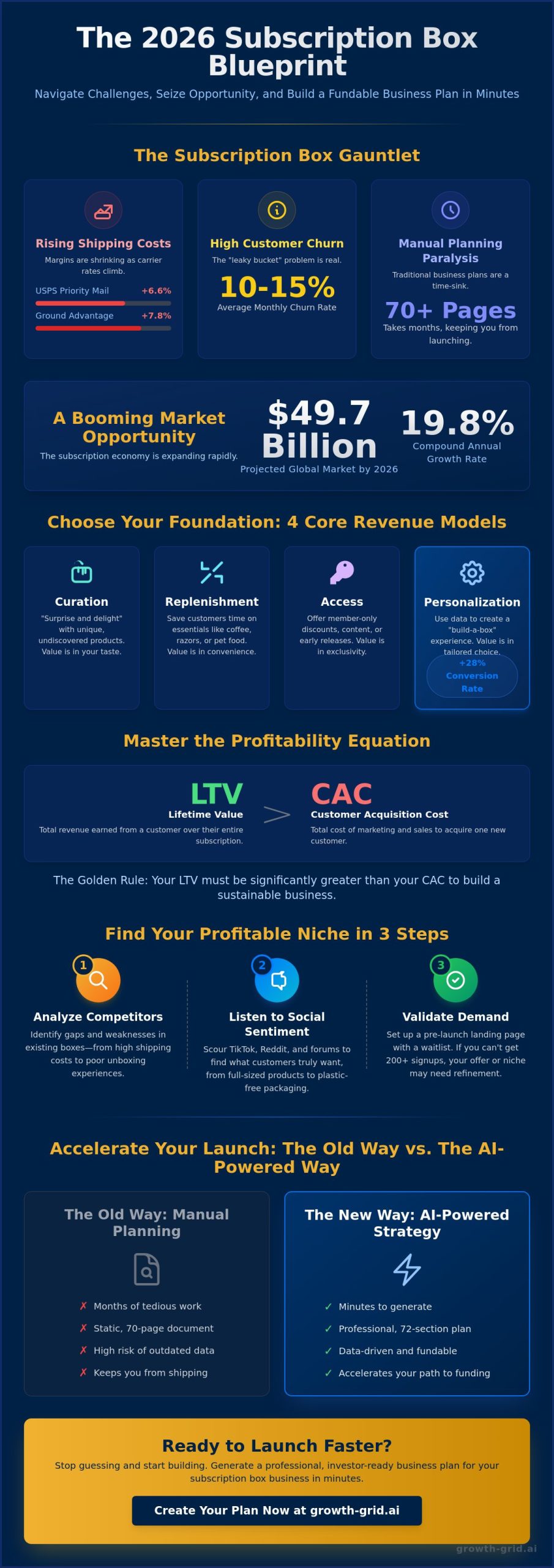
Your subscription box business will fail if you treat it like a retail store instead of a math equation. It’s a hard truth to accept while you’re busy sourcing products. You’re likely feeling the pressure of the 2026 shipping landscape, where USPS Priority Mail rates have jumped by 6.6% and Ground Advantage is up 7.8%. Writing a traditional, 70-page business plan for a subscription box service manually is a massive time-sink that keeps you away from actually shipping orders. You need a strategy that handles the 10-15% average churn rate without draining your mental energy.
We’re here to change that. You can master the recurring revenue model and build a professional, fundable business plan in minutes, not months. This guide provides a launch-ready operational strategy focused on the metrics that matter most. We’ll examine how to navigate the latest FTC “click-to-cancel” rulemaking and manage the “add-on” economy to boost your customer lifetime value. You’ll get a clear roadmap to transform your vision into a streamlined, profitable reality.
Key Takeaways
- Define your foundation by choosing between curation, replenishment, or access models to establish a clear value proposition.
- Identify profitable market gaps by analyzing competitor churn rates and social media sentiment within your chosen niche.
- Master the financial metrics of a business plan for a subscription box service by calculating precise Customer Acquisition Cost (CAC) and Lifetime Value (LTV).
- Optimize your operational strategy by balancing high-quality unboxing experiences with weight-conscious packaging to protect your margins.
- Accelerate your path to funding by using an AI Business Plan Generator to produce a professional, 72-section document in minutes.
Choosing Your Subscription Model: The Foundation of Your Plan
Your business model is the engine of your entire operation. Stop thinking about product curation for a moment and focus on the revenue architecture. In a legacy retail model, you have to win the customer over for every single transaction. It’s exhausting and expensive. The subscription box business model flips this script. It replaces one-time sales with predictable, recurring revenue. This stability allows you to forecast inventory and manage cash flow with precision. When you sit down to write a business plan for a subscription box service, your choice of model dictates every subsequent operational decision.
The Primary Subscription Archetypes
Defining Your UVP in 2026
The global market in 2026 is projected to reach up to $49.7 billion. It’s crowded. You can’t just be another box of stuff. Your UVP must be sharp and immediately obvious. Are you offering hyper-personalization through AI? Are you the only 100% plastic-free option in your niche? Identify one specific gap in the market. Use your first 12 months to dominate that narrow space. Set aggressive but realistic objectives. Aim for a specific subscriber milestone, like 500 active users, and a churn rate below the 10% industry average. Clear targets turn a vague idea into a professional strategy.
Writing the Executive Summary for Investors
Investors scan; they don’t read. Your executive summary needs to be a high-speed pitch that proves you’ve done the work. Summarize your niche and target audience in three punchy sentences. Highlight your projected growth based on current market trends, noting that the sector is growing at a compound annual rate of up to 19.8%. Clearly quantify your funding requirements and exactly how you intend to use that capital. Whether it’s for initial inventory or customer acquisition, be specific. This level of transparency is what makes a business plan for a subscription box service actually fundable.
Market Research: Finding Your Profitable Subscription Niche
Market research in 2026 requires a surgical approach. You can’t rely on gut feelings when the global subscription market is projected to reach up to $49.7 billion. To build a robust business plan for a subscription box service, you must first calculate your Total Addressable Market (TAM) using current demographic data. Focus on the fastest-growing sectors like pet care or niche food and beverage. Don’t just identify who your competitors are; identify why their customers are leaving. With average monthly churn rates sitting between 10% and 15%, there’s a massive opportunity to capture dissatisfied subscribers by solving common pain points like “filler” items or poor unboxing experiences.
Social media sentiment is your secret weapon. Scour TikTok and niche forums to see what people actually value. Are they tired of excessive plastic? Are they looking for full-sized products over samples? Validating demand before you spend a dime on inventory is essential. Set up a pre-launch landing page with a waitlist. If you can’t get 200 sign-ups in a short window, your niche might be too narrow or your offer too weak. This data-driven validation ensures that when you write a comprehensive business plan, your projections are based on real-world interest.
Competitive Analysis Framework
Start by mapping out your top five competitors. Contrast their pricing tiers, shipping speeds, and packaging styles. Look for weaknesses you can exploit, such as high residential surcharges or a lack of personalization. You can use proven startup business plan tactics to differentiate your brand from legacy players. If a competitor is hit by the 2026 UPS residential surcharge of $6.50, find a way to optimize your logistics or bundle products to offer a more attractive price point.
Defining Your Ideal Subscriber Profile
Create detailed personas that go beyond simple demographics. Understand their spending habits and emotional triggers. Does your audience hang out on TikTok for unboxing videos, or are they on niche forums discussing sustainability? Your sourcing must align with these values. If your persona values eco-friendly living, your plan must detail ethically sourced products and compostable packaging. This alignment reduces churn and increases lifetime value. If you want to streamline this entire research phase, using a professional AI Business Plan Generator can save you weeks of manual data entry while ensuring your niche analysis is bulletproof.
The Subscription Math: LTV, CAC, and Financial Projections
Subscription box success is a math problem, not a curation problem. If you don’t master your metrics, you’re just shipping boxes at a loss. A professional business plan for a subscription box service must prioritize a “retention-first” framework. This means looking past the initial sale and focusing on the long-term profitability of every customer. You need to calculate your Customer Acquisition Cost (CAC) across every marketing channel, from TikTok ads to niche influencer partnerships. Understanding whether a subscriber from Instagram costs more than one from a referral program is vital for scaling your budget efficiently.
The “Magic Ratio” for sustainability is 3:1. Your Lifetime Value (LTV) should be at least triple your CAC. If it costs you $30 to acquire a subscriber, that customer needs to generate $90 in gross profit before they cancel. Remember that the average monthly churn rate in 2026 sits between 10% and 15%. Your revenue projections must account for this “Churn Factor” immediately to avoid overestimating your bank balance. Focus on these three pillars:
- LTV: Measures total profit per customer over their entire subscription lifecycle.
- CAC: Quantifies the total investment required to win a single new subscriber.
- Churn: Tracks the percentage of your audience leaving each month, directly impacting your LTV.
Don’t forget that 68% of churn is often involuntary, usually due to failed payments or expired cards. Automated dunning sequences aren’t just a technical feature; they are a vital part of your financial strategy that protects your recurring revenue.
Building Your Cash Flow Forecast
Inventory is a liquidity trap. You often pay for products months before a subscriber pays you. A detailed cash flow analysis helps you navigate these gaps without running out of capital. Factor in seasonal spikes and the 2026 payment processing fees, like Stripe’s 2.9% plus $0.30 per charge. Your gross margins must stay healthy after accounting for product costs, custom packaging, and rising shipping rates.
Pricing Strategy for Profitability
Pricing must incentivize the right behavior. Annual billing is a powerful tool because it locks in LTV and provides immediate cash flow. Compare your monthly, quarterly, and annual tiers to see which drives the highest retention. To boost average order value, plan for “Add-on” revenue streams. Selling premium items inside a regular shipment is a low-cost way to increase profit. Determine your break-even point early to know exactly how many active subscribers you need to cover overhead.
Operations & Logistics: Sourcing, Packing, and Shipping
Operational efficiency is where your margins are made or lost. In 2026, shipping is your biggest hurdle. You can’t ignore the fact that USPS Ground Advantage rates have jumped by 7.8%, while UPS and FedEx have implemented 5.9% general rate increases. Your business plan for a subscription box service must detail a logistics strategy that offsets these costs without compromising the customer experience. This involves a delicate balance between premium unboxing and weight management. Every extra ounce in your packaging is a direct hit to your bottom line.
Decide early whether you’ll manage fulfillment in-house or hire a third-party logistics (3PL) partner. In-house packing gives you total control over the unboxing experience but requires significant space and labor. A 3PL offers scale but adds a per-box fee that must be factored into your “Subscription Math” from the previous section. Use a professional AI Business Plan Generator to build an operational checklist that covers every step from the warehouse to the customer’s doorstep.
The Sourcing Workflow
Your sourcing strategy needs to be diverse and resilient. Identify your “hero” items; these are the high-value products that drive unboxing videos and social media shares. Balance these with “filler” items that provide bulk and perceived value at a lower cost. Build relationships with wholesalers and local artisans to ensure a steady supply. Most importantly, create a backup supplier list. Supply chain disruptions are inevitable, and a backup plan prevents the “empty box” scenarios that spike your churn rate.
Logistics and Fulfillment Strategy
Choose the shipping rhythm that fits your cash flow. Batch shipping involves sending all boxes on a single day each month, which is efficient for inventory management. Rolling shipping sends boxes as orders come in, which is better for consistent labor demand. Map out the unboxing experience to drive organic marketing on TikTok and Instagram. Remember that 2026 shipping surcharges are steep; the UPS residential surcharge is now $6.50 per package. To maintain profitability, implement a clear returns and damaged item protocol that minimizes losses. Design your boxes for the camera, but ship them for the scale.
Launch Fast: Generating Your Plan with AI in 15 Minutes
Stop wasting months on a document that should take minutes. The biggest barrier to starting your subscription box isn’t sourcing or shipping; it’s the “blank page” syndrome. Writing a comprehensive business plan for a subscription box service manually is a legacy approach that kills momentum. While you’re obsessing over margin formatting, your competitors are already securing their first 500 subscribers. You need to move faster. AI has transformed business planning from a multi-week ordeal into a 15-minute task.
Why Traditional Planning is Obsolete
Traditional methods are slow and prone to human error. A manual plan often requires 100+ hours of research, writing, and financial modeling. By the time you finish, your market data might already be outdated. Modern ai business plan tools allow you to stay agile and responsive to 2026 market shifts. You can generate a 72-section plan tailored specifically to recurring revenue models without the stress of manual data entry. This isn’t just about speed; it’s about precision. AI eliminates the formatting errors and structural gaps that make investors hesitate. You get a professional output that looks like it was written by a high-end consultant.
From Plan to Profit with GrowthGrid
Efficiency is your competitive advantage. GrowthGrid acts as your pragmatic partner, identifying the most effective workflow for your specific niche. You enter your subscription idea and let the AI build the strategy. It integrates the complex subscription math we discussed earlier, ensuring your LTV and CAC projections are realistic and fundable. You gain access to professional business plan software features that guide you through every operational detail. This includes everything from your sourcing workflow to your returns protocol.
Once your plan is generated, you can download it in PDF or DOC format for immediate sharing. This means you can walk into a meeting with a complete, professional strategy just minutes after starting. Your time is better spent on product curation and unboxing experiences than on wrestling with a word processor. Focus on scaling your recurring revenue while the AI handles the structural heavy lifting. It’s time to build a launch-ready operational strategy without the traditional overhead. Generate your subscription box business plan now and move from idea to profit today.
Take Command of Your Recurring Revenue Future
Success in the 2026 subscription market requires more than just great products. You must master the “Subscription Math” by maintaining a healthy 3:1 LTV to CAC ratio. You also need a resilient logistics strategy to navigate rising shipping surcharges and evolving regulatory requirements. A professional business plan for a subscription box service is no longer an optional document; it’s your roadmap to surviving high churn and scaling your operations. Stop letting the fear of a blank page stall your launch.
Thousands of global startups have already abandoned the manual writing process. You can join them by using an AI-powered system that delivers 72-section comprehensive plans complete with accurate financial projections. Don’t waste weeks on structural formatting when you could be focusing on your unboxing experience and customer acquisition. It’s time to transition from an idea to a fundable, launch-ready business strategy with total confidence.
Create your subscription box business plan in 15 minutes. You have the vision and the niche. Now, get the professional documentation you need to secure funding and start shipping.
Frequently Asked Questions
How much does it cost to start a subscription box business in 2026?
Starting costs typically range from $2,000 to $10,000 for initial inventory, branding, and platform fees. You must budget for 2026 shipping realities, such as the UPS Ground minimum charge of $11.99 per package. Payment processing also impacts your budget, with Stripe charging 2.9% plus $0.30 per transaction for volumes under $1 million. Focus on lean sourcing to keep your initial overhead manageable while you build your subscriber base.
What is a good churn rate for a new subscription box service?
A healthy monthly churn rate for a new service is between 5% and 8%, though the industry average sits between 10% and 15%. Aiming for a lower rate is essential because 68% of churn is often involuntary due to failed payments. Your business plan for a subscription box service should include strategies like automated dunning emails to recover these lost subscribers and protect your recurring revenue from unnecessary leaks.
Do I need a business plan to get a merchant account for subscriptions?
Yes, most traditional banks and high-risk merchant providers require a professional business plan to assess your risk level. They want to see your projected churn rates and how you handle “click-to-cancel” compliance following the latest FTC rulemaking. Providing a structured document proves you’re a professional operator with a clear strategy for managing chargebacks and recurring billing cycles. It removes perceived risk and speeds up your account approval process.
How do I find reliable suppliers for my subscription box items?
Start by attending trade shows or using wholesale platforms like Faire to identify potential partners. You can also contact local artisans for unique “hero” items that differentiate your box from mass-market competitors. Always build a backup supplier list to prevent “empty box” scenarios caused by supply chain delays. Reliability is key, so request samples to verify quality before including any item in your official financial projections.
What are the most profitable subscription box niches right now?
Beauty and food remain the largest segments, but the pet market is currently the fastest-growing category in 2026. Niche boxes catering to underserved communities or specific hobbies also show high profitability due to lower competition and higher loyalty. Focus on areas where subscribers favor high-quality, full-sized products over small samples. This strategy increases your perceived value and helps you maintain a much higher customer lifetime value.
Can I use AI to write my entire subscription business plan?
You can use an AI Business Plan Generator to produce a comprehensive, 72-section business plan for a subscription box service in about 15 minutes. This technology bypasses the “blank page” syndrome by handling the structural heavy lifting and financial formatting. It allows you to focus on your unboxing experience while the software ensures your strategy is professional and ready for investor review or merchant account applications.
How do I calculate the shipping costs for my business plan?
Use current 2026 rates from major carriers, factoring in the 5.9% general rate increase implemented by UPS and FedEx. Don’t forget surcharges, such as the $6.45 FedEx Home Delivery fee or the $6.50 UPS ground residential surcharge. Calculate your total landed cost by adding the price of the box, packing materials, and the actual postage based on your package weight. This precision prevents shipping costs from eating your margins.
What is the difference between a curated box and a replenishment box?
A curated box focuses on “surprise and delight” by offering a selection of new products based on a theme. A replenishment box provides essential items that customers use regularly, such as razors or coffee, on a set schedule. Curated boxes rely on your sourcing skills and brand taste. Replenishment models succeed by providing maximum convenience and saving the customer time on recurring household needs.