

What if your “too small” market is actually your biggest competitive advantage? With 58% of small businesses now using generative AI to streamline operations, learning how to write a business plan for a niche market has never been more efficient. You likely feel the friction of traditional planning. You worry that a lack of niche market data makes your strategy look weak to investors, or you’re simply overwhelmed by the 70+ sections usually required in a professional document. It’s a common frustration, but legacy methods are no longer the standard.
You’re about to master the art of hyper-segmented planning and build a profitable, scalable business in minutes. This guide provides a modern framework to justify your niche strategy and prove your profitability to any stakeholder. We will show you how to prioritize data depth over market breadth to secure funding and dominate your space. Get ready for a clear roadmap that moves you from a specialized startup to a scalable powerhouse without the high overhead or wasted time.
Key Takeaways
- Identify high-conversion psychographics to differentiate your specialized strategy from broad, generic market competitors.
- Master how to write a business plan for a niche market using “Proxy Data” to overcome the lack of traditional industry reports.
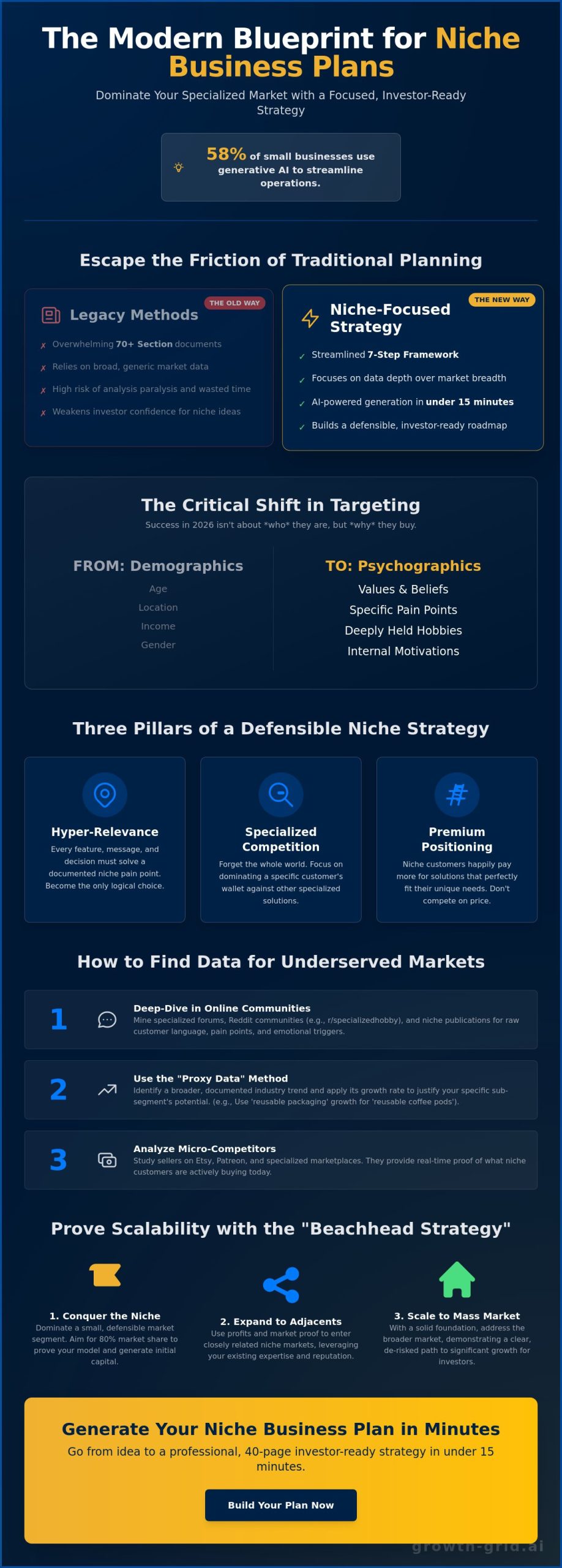
- Execute a streamlined 7-step framework that replaces overwhelming 70-section documents with a focused, investor-ready roadmap.
- Apply the “Beachhead Strategy” to prove your long-term scalability and eliminate investor fears regarding market size limitations.
- Eliminate analysis paralysis by leveraging automated tools to generate a professional, 40-page niche strategy in under 15 minutes.
What is a Niche Market Business Plan and Why is it Different?
A niche business plan is a specialized roadmap designed to dominate a highly specific, often underserved segment of the economy. While a standard plan tries to cast a wide net, a niche strategy focuses on a narrow target to achieve high conversion and intense customer loyalty. Understanding What is a Niche Market? is the first step in realizing that success here requires depth, not breadth. You aren’t just selling a product; you’re solving a specific problem for a specific group of people.
When you learn how to write a business plan for a niche market, you must avoid the “General Market” trap. Using broad industry data is the fastest way to lose investor trust. If you’re building a business for sustainable urban beekeepers, national honey production stats won’t help you. Your plan must stand on three essential pillars:
- Hyper-Relevance: Every feature must solve a documented niche pain point.
- Specialized Competition: You’re fighting for a specific wallet, not the whole world.
- Premium Positioning: Niche customers pay more for solutions that actually fit.
The Shift from Demographics to Psychographics
In 2026, age and location are secondary. Your plan should focus on values, specific pain points, and deeply held hobbies. Micro-segmentation allows you to identify your first 1,000 true fans by looking at where they hang out online and what they believe. Psychographic targeting for niche markets means defining your audience by their internal motivations and behavioral triggers rather than their external census data.
Why Traditional Templates Often Fail Niche Founders
Standard industry benchmarks are often useless in a non-standard market. Most templates ask for broad market share projections that don’t apply when you’re aiming for 80% of a tiny segment. You need to customize your business plan to highlight your unique moats, such as proprietary community access or specialized technical expertise. This shows you have a defensible position that generic competitors can’t easily replicate.
Don’t let the “Small Total Addressable Market” (TAM) objection stop you. Address it early by showing high lifetime value (LTV) and low acquisition costs. A small market with high margins is often more profitable than a massive market with razor-thin ones. Focus on your “Beachhead Strategy” to show how conquering this niche provides the capital to expand later. Efficiency is your greatest asset here. Prove that you can own your corner of the market before you worry about the rest of the world.
Deep-Dive Research: Finding Data for Specialized Markets
Traditional market research often fails niche founders because general census data lacks the granularity required for hyper-segmented strategies. If you rely on broad NAICS codes, you’ll find data for “Pet Services” but nothing for “Holistic Reiki for Senior Dogs.” To master how to write a business plan for a niche market, you must look where the data is actually hiding. Your primary sources should be specialized forums, active Reddit communities, and niche trade publications where your target audience already congregates. These spaces reveal the emotional triggers and specific language your customers use, which is data you can’t find in a government spreadsheet.
When direct data doesn’t exist, use the “Proxy Data” method. This involves identifying a broader industry trend and applying its growth rate to your specific sub-segment. For instance, if the global reusable packaging market is projected to reach $190 billion by 2030, a niche founder focusing on reusable coffee pod filters can use that macro-trend to justify their micro-market growth. You can refine these insights by studying “micro-competitors” on platforms like Etsy, Patreon, or specialized marketplaces. These platforms provide real-time proof of what customers are actually buying today, not what they bought two years ago when a government report was last updated.
Social listening is another critical tool for validating your niche. By tracking specific keywords and sentiment across social media, you can identify gaps in current solutions. The Niche Business Plan Framework requires this level of validation to prove to investors that your “small” market is actually a highly motivated community with unmet needs. If you need a faster way to gather these insights, consider using a modern strategy tool to automate your discovery phase and skip the manual data entry.
Calculating TAM, SAM, and SOM for Niche Markets
In a niche plan, your Total Addressable Market (TAM) might look smaller than a general retailer’s, but your Serviceable Obtainable Market (SOM) is often much more realistic and attainable. Investors care about your ability to capture a specific segment quickly. Focus on proving that your high margins and low customer acquisition costs make a smaller SOM more profitable than a massive, competitive one. Niche focus allows for premium pricing because you are providing a tailored solution that generic brands cannot match.
Using AI for Rapid Niche Market Analysis
The manual research process that used to take 40 hours can now be completed in 15 minutes. AI tools can synthesize thousands of customer reviews from specialized marketplaces into a single “Pain Point Map.” This allows you to see exactly where your competitors are failing and where your product can win. For a deeper look at these automated strategies, check out our AI Business Plan guide. Speed is your competitive advantage. Use it to outpace legacy competitors who are still stuck in manual spreadsheets and outdated research methods.
The 7-Step Niche Business Plan Framework
A successful niche strategy requires more than just a smaller target. It demands a specialized framework for establishing a company that prioritizes depth over scale. When you learn how to write a business plan for a niche market, you must move beyond generic templates that treat all customers the same. Your framework should be a surgical tool designed to carve out a defensible position in an underserved space.
- Step 1: The Hyper-Specific Executive Summary. Lead with the “Why.” Don’t just summarize the business; explain the specific gap in the market that generic competitors are too large or too slow to fill.
- Step 2: The Problem-Solution Fit. Contrast your specialized solution against generic alternatives. Prove that while a general product solves 60% of the customer’s problem, your solution solves 100% of their niche pain points.
- Step 3: The Specialized Marketing Plan. Forget broad Facebook ads. Focus on community-led growth, niche influencers, and Discord or Reddit communities where your audience already trusts the moderators.
- Step 4: Operational Moat. Identify what makes your execution hard to copy. This could be a proprietary supplier for rare materials or a deep technical certification that takes years to acquire.
- Step 5: Financial Projections with Niche Margins. Niche businesses often support 20% to 50% higher margins than generalist retailers. Show how your premium positioning offsets the smaller customer base.
Implementing these steps ensures your document isn’t just a formality but a functional roadmap. Knowing how to write a business plan for a niche market means accepting that you won’t be everything to everyone. You are aiming for total dominance within a specific boundary.
Crafting a UVP That Resonates
Your Unique Value Proposition (UVP) is the heartbeat of your plan. Use this formula: [Target Audience] + [Specific Problem] + [Unique Solution]. For example, instead of “software for businesses,” your UVP should be “Waitlist management software for boutique yoga studios with high teacher turnover.” A great niche UVP should actively repel the wrong customers. By being clearly “not for everyone,” you become the only logical choice for your specific segment.
Budgeting for Niche Customer Acquisition
Customer Acquisition Cost (CAC) is often higher in niche markets because you’re hunting for a needle in a haystack. However, the Lifetime Value (LTV) is massive because niche customers are famously loyal. Focus your budget on referral loops and community partnerships rather than broad search terms. Use a detailed cash flow analysis to manage your burn rate during the early acquisition phase. High margins will eventually cover the initial cost, but you must plan for that gap in your early-stage projections.
Scaling Strategy: Moving from Niche to Mass Market
Investors often fear that niche markets are a dead end. They ask: “What happens when you run out of customers?” You must answer this by defining a clear Beachhead Strategy in your document. Conquering one hyper-specific segment isn’t the final goal; it’s the funding mechanism for your next move. By dominating a small space, you build the brand authority and cash reserves needed to expand into adjacent markets without the high risk of a broad launch. This approach proves that your business is both defensible and scalable.
Learning how to write a business plan for a niche market requires you to think three steps ahead. Your initial niche is your proof of concept. Once you’ve captured a significant portion of that segment, you look for adjacent niches that share similar psychographics. If your first audience values extreme sustainability and DIY technology, your next audience should too, even if they operate in a different industry. This keeps your brand authority intact while your revenue grows. You aren’t just selling to more people; you’re selling to similar people in new categories.
Maintaining brand authority during expansion is a balancing act. You must ensure your core message remains strong even as your product line grows. If you started as the expert in “Vegan Leather for High-End Watch Straps,” moving into “Vegan Leather for Luxury Handbags” is a natural progression. Moving into “General Plastic Goods” would kill your premium positioning. Growth must be logical, calculated, and data-driven. Build your growth roadmap today to ensure your expansion is as profitable as your launch.
The Adjacent Market Roadmap
Your initial plan must outline expansion goals for Year 3 and Year 5. Criteria for choosing the next segment should prioritize similarity in customer behavior over simple market size. It’s better to move into a smaller, highly profitable adjacent niche than a massive, low-margin general market. Brand elasticity is the critical measure of how far your brand can stretch into new categories without losing the trust of your original “true fans.”
Technology as a Scaling Lever
As you expand, your strategy must remain agile. Use business plan software to iterate your projections and market analysis in real time. Automating your core operations allows you to maintain high niche margins even as your overhead increases. For instance, haulage and freight operators can utilize Logivo.ai to manage transport logistics with AI precision, keeping operations lean during growth. AI tools are also essential for monitoring competitor moves in new segments, giving you the speed advantage needed to capture adjacent markets before legacy brands can react. With 58% of small businesses now utilizing generative AI as of 2026, staying manual is no longer a viable option for those who want to scale fast.
Generate Your Niche Business Plan in 15 Minutes with GrowthGrid
Stop wrestling with outdated templates. Manual niche planning is the primary cause of analysis paralysis for modern founders. You shouldn’t have to spend 40 hours hunting for data that legacy systems simply can’t find. GrowthGrid’s AI Business Plan Generator is the modern solution to this legacy problem. It handles the heavy lifting of market research and financial modeling so you can focus on building your brand. Speed is your most valuable asset, and we ensure you don’t waste it on manual data entry.
Learning how to write a business plan for a niche market requires surgical precision. GrowthGrid delivers a 72-section, 40+ page document in under 15 minutes. This isn’t a generic summary. It’s a deep-dive strategy that uses advanced computing to bridge the “data gap” often found in specialized industries. As of 2026, 58% of small businesses are already using generative AI to gain a competitive edge. Don’t let your competition outpace you because they adopted better tools first. Our platform ensures your document is investor-ready from the moment you hit export.
- Legacy Method: 40+ hours of research, generic templates, and high stress.
- GrowthGrid Method: 15 minutes, 72-section precision, and total confidence.
How the GrowthGrid AI Process Works
The workflow is designed for maximum efficiency. First, you answer a series of simple questions about your niche idea and target audience. Next, the AI gathers industry-specific data and financial benchmarks tailored to your segment. Finally, you review and customize your 70+ page document instantly. You get the depth of a human consultant with the speed of advanced technology. It’s a streamlined process that removes the perceived risk of starting a specialized business.
Beyond the Plan: Legal and Operational Support
Success in a specialized market requires more than just a roadmap. You need the right infrastructure to protect your moats. GrowthGrid offers an AI Legal Document Generator to create NDAs and contracts for your niche partners. You can also use our AI HR Document Generator to onboard specialized talent or our AI Strategy Document Generator as your market evolves. We act as your pragmatic problem-solver, providing the tools you need for every stage of growth.
Every document you generate is available in professional PDF and DOC formats for immediate pitching. Whether you are seeking venture capital or a local partnership, your presentation will look polished and authoritative. Efficiency isn’t just about saving time; it’s about maximizing your professional impact. Start your niche business plan for free today and move from idea to execution in minutes.
Dominate Your Niche with a 2026 Strategy
You’ve seen that niche success isn’t about being small; it’s about being focused. By prioritizing psychographics over broad demographics and utilizing the “Proxy Data” method, you can validate any specialized idea. Mastering how to write a business plan for a niche market is the difference between a struggling startup and a market leader. You now have the 7-step framework to prove your profitability and build a defensible moat that generic competitors can’t touch. Conquering your “beachhead” is just the beginning of a scalable, high-margin journey.
Don’t let analysis paralysis stall your progress. You can bypass the weeks of manual research and complex document formatting right now. Generate your professional niche business plan in 15 minutes. Our AI-driven platform delivers a 72-section comprehensive plan including automated financial projections and instant PDF or DOC exports. It’s time to stop planning and start leading. Your specialized market is waiting for a solution only you can provide. Build it today.
Frequently Asked Questions
Is a niche market too small for a business plan?
No, a niche market is never too small for a formal strategy; in fact, it’s where a plan is most critical for proving viability. A professional document allows you to justify high margins and low overhead to potential partners. It’s the only way to demonstrate that a smaller, dedicated audience can be more profitable than a broad, generic one with high competition.
How do I find market size for a very specific niche?
Use the “Proxy Data” method and social listening to estimate your market size when official reports are too broad. Analyze specialized forums, Reddit communities, and micro-competitor sales on platforms like Etsy or Patreon. This provides real-time behavioral data and proof of demand that broad census reports often miss.
Can I use a standard business plan template for a niche market?
Standard templates often fail niche founders because they focus on broad reach rather than hyper-segmented conversion. When learning how to write a business plan for a niche market, you need a framework that prioritizes your Unique Value Proposition (UVP). You must replace generic industry benchmarks with specific psychographic data that reflects your audience’s actual values.
How do I convince investors that my niche is profitable?
Convince investors by highlighting high Lifetime Value (LTV) and a clear “Beachhead Strategy” for future expansion. Show them that while the initial segment is specialized, the lack of direct competition allows for premium pricing. Intense customer loyalty in niche spaces often leads to lower acquisition costs over time compared to general markets.
What is the most important section of a niche business plan?
The Unique Value Proposition (UVP) is the most critical section of any niche-focused document. This section must clearly explain why your solution is the only logical choice for your specific segment. It should prove that your product solves 100% of a specialized pain point, whereas general competitors only solve a fraction.
How often should I update a niche market business plan?
Update your niche strategy at least every six months to stay ahead of shifting customer behaviors and new micro-competitors. Niche markets move fast. Regular updates ensure your roadmap remains relevant as you gather more data on your audience’s needs and identify expansion opportunities into adjacent markets.
Should I mention competitors in a niche market plan if there are none?
Yes, always mention competitors, even if they are indirect alternatives or broad generic brands that currently serve your audience poorly. Investors often view “no competition” as a lack of market demand. Identifying how customers currently struggle with generic tools highlights the specific gap your specialized product fills.
How does AI help in writing a niche business plan?
AI accelerates the research phase by synthesizing thousands of customer reviews and niche data points in minutes. Modern generators handle the heavy lifting of market analysis and financial projections. This allows you to produce a 72-section plan with professional formatting without the 40+ hours of manual labor usually required by legacy methods.