

Stop drafting 40-page documents that nobody will ever read. For the 29.8 million solopreneurs currently contributing $1.7 trillion to the economy, a traditional business plan is often a graveyard of irrelevant data. You don’t need a complex organizational chart when you are the entire team. If you’ve spent hours staring at corporate templates and feeling like a “fake” business owner, you aren’t alone. It’s time to build a business plan for a solopreneur that actually works for a one-person powerhouse.
We agree that your time is your most valuable asset. You’ve likely felt the sting of “shiny object syndrome” because you lacked a focused strategy. This guide promises to replace that confusion with a high-impact, actionable roadmap tailored for 2026. We will strip away the corporate jargon to focus on your pricing, market position, and the systems that drive results. You’ll walk away with a document that helps you filter opportunities and scale your impact without the overhead of a traditional office.
Key Takeaways
- Identify the five essential pillars that transform a generic document into a high-impact strategy built specifically for a one-person business.
- Learn why traditional 40-page corporate models fail and how to replace them with a lean roadmap focused on immediate execution over empty explanation.
- Discover how to choose the right framework for your business plan for a solopreneur, comparing one-page canvases against 12-month roadmaps.
- Follow a streamlined five-step process to validate your market position and define your primary revenue stream without wasting time on irrelevant data.
- Leverage modern AI tools to automate your strategic planning and eliminate “blank page” syndrome in under 15 minutes.
Why Traditional Business Plans Fail Solopreneurs (and What to Do Instead)
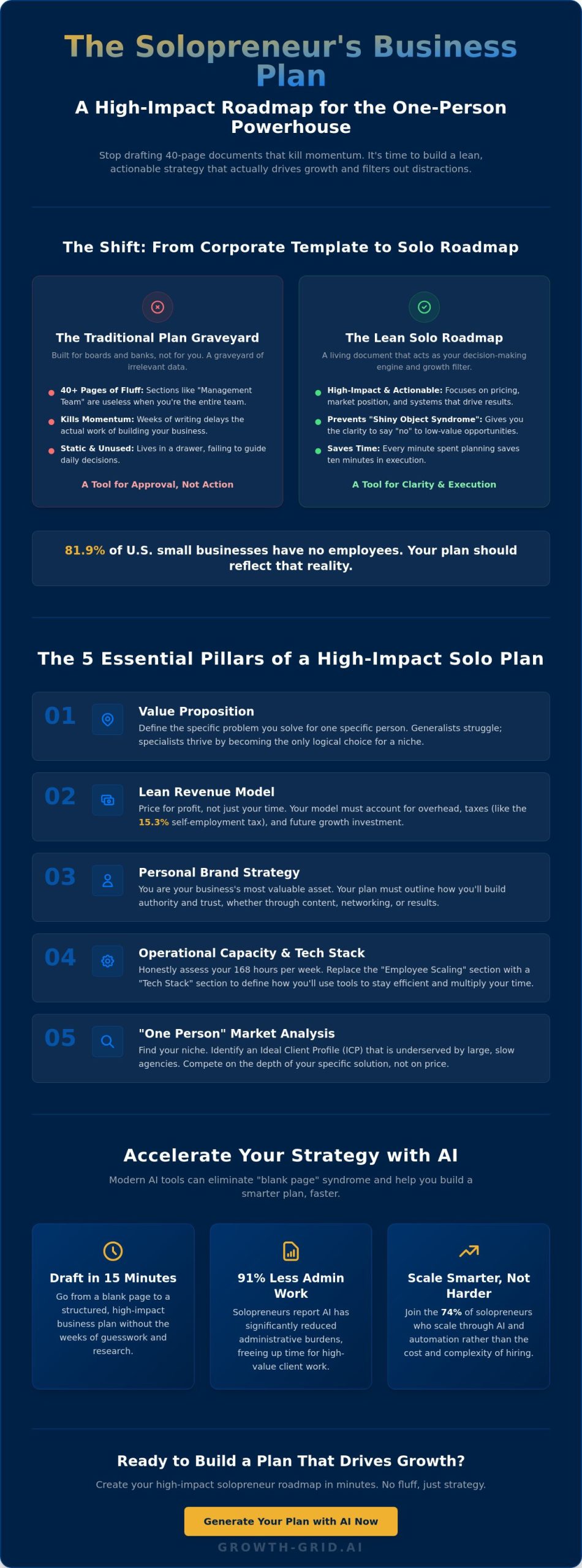
Traditional planning models are built for boards of directors and bank managers. They assume you have a marketing department and a legal team. You don’t. For a one-person powerhouse, the standard what is a business plan definition often feels like a homework assignment rather than a strategy. A high-impact business plan for a solopreneur is a lean roadmap. It prioritizes execution over explanation. It’s about your survival and growth, not someone else’s approval.
The “Planning Trap” is real. Spending weeks on a 40-page document doesn’t build a business; it delays one. Since 81.9% of small businesses in the U.S. have no employees, writing about “Management Teams” or “Organizational Charts” is purely performative. This fluff kills your momentum. You need internal clarity to move forward. A solo plan is a tool for you to transition from a “freelancer” reacting to emails to a “business owner” driving a system. It’s the difference between working in your business and working on it.
The Purpose Shift: Your Plan as a Decision-Making Engine
Your plan shouldn’t live in a desk drawer. It belongs in your task manager as a living document. It acts as a filter for every new opportunity. When a low-value client approaches you with a project that doesn’t align with your 12-month roadmap, your plan gives you the confidence to say “no.” This prevents “Shiny Object Syndrome” from draining your energy. It ensures you focus on the specific revenue streams that actually pay the bills. Every minute spent on your plan should save you ten minutes in execution.
Ditching the Fluff: Sections You Can Safely Ignore
Stop wasting time on corporate templates. You can safely delete the “Management Team” section and the “Funding Request” unless you are part of the small minority seeking venture capital. If you are one of the 50% of solopreneurs who started with less than $5,000, your plan should focus on cash flow, not pitch decks. Replace the “Employee Scaling” section with a “Tech Stack” section. In 2026, 74% of solopreneurs scale through AI rather than hiring. Focus on your personal capacity and the systems that multiply your time. A business plan for a solopreneur should be as agile as the person running it.
The 5 Essential Pillars of a High-Impact Solo Business Plan
Building a business plan for a solopreneur requires a shift from volume to value. You aren’t managing a massive payroll; you’re managing a reputation and a limited clock. While the SBA guide to writing a business plan offers excellent foundational structures, the solo version must be leaner. Focus on these five pillars to ensure your business remains a profit center, not a high-stress hobby. If you want to move faster, using an AI Business Plan Generator can help you draft these pillars in minutes rather than weeks.
The first pillar is your Value Proposition. You must define the specific problem you solve for one specific person. Generalists struggle to command high rates. Experts thrive by being the only logical choice for a niche. Second, your Lean Revenue Model must account for the 15.3% self-employment tax rate in 2026. Don’t just price for your time. Price for your overhead, your taxes, and your future growth. Your third pillar is Personal Brand Strategy. You are the business’s most valuable asset. Your plan should outline how you’ll build authority through content or networking. Finally, Operational Capacity is your most honest pillar. You have 168 hours a week. Your plan must reflect how you’ll use tools to stay efficient, as 91% of solopreneurs report that AI has reduced their administrative work.
The “One Person” Market Analysis
Generalists often face a solo death sentence. To stand out against large agencies, you must be nimble. Agencies are slow and expensive. You are fast and specialized. Use your market analysis to identify an “Ideal Client Profile” (ICP) that is currently underserved. Instead of competing on price, compete on the depth of your specific solution. This focus streamlines your marketing and makes your sales process nearly automatic.
Financial Projections for the Bootstrapped Solo
You need two numbers: your “Survival Number” and your “Growth Goal.” Your survival number covers your basic living expenses, taxes, and software. Your growth goal includes reinvesting in your tech stack or hiring contractors. Integrating a regular cash flow analysis into your monthly routine is non-negotiable. Since 36% of solopreneurs earn less than $25,000 per year, staying on top of your numbers is the only way to ensure you don’t become a statistic. Plan for a “Rainy Day” fund immediately. When you are the only earner, financial padding is your best strategy for long-term peace of mind.
Solo Strategy vs. Startup Pitch: Choosing Your Framework
Stop trying to fit a solo venture into a venture capital mold. A startup pitch is designed to persuade others to give you money. Your business plan for a solopreneur is designed to persuade you to stay focused. You must choose a framework that serves your current phase of growth. Whether you need a single page for rapid testing or a multi-section roadmap for long-term scaling, the structure must drive action. Choosing the wrong framework wastes energy; choosing the right one creates a competitive edge.
The One-Page Plan: For Rapid Execution
The One-Page Plan is the gold standard for rapid execution. It’s ideal for freelancers and service providers who need to validate a new offer quickly. Instead of writing chapters on market history, you focus on four variables: the problem, your solution, key performance metrics, and your unique value. This is where the “Lean Canvas” framework shines. It allows you to pivot your strategy in hours, not months. For a deeper dive into this format, check out our one page business plan guide to see how to condense your vision without losing impact.
The Comprehensive Roadmap: For Long-Term Scalability
If your goal is to build a productized service or digital assets that function without your constant input, a Comprehensive Roadmap is necessary. This isn’t fluff. It’s a risk management tool. A deeper market analysis prevents expensive pivots 18 months down the line. It also prepares you for the moment you make your first hire. Even if you plan to stay solo, having a structured document provides professional credibility when dealing with high-end partners or enterprise clients. You can find excellent university business plan resources to help you structure these more detailed sections effectively.
Your 2026 business goals should dictate your format. If you’re testing an AI-driven service, speed is your priority. Use a lean framework. If you’re building a legacy brand, invest the time in a roadmap. A detailed business plan for a solopreneur might seem like overkill; however, it can be the difference between being seen as a “gig worker” or a legitimate business entity. Match your plan to your ambition. Don’t build a skyscraper on a tent-peg foundation. Use your framework as a bridge between where you are and where you intend to be by year-end.
How to Write Your Solopreneur Business Plan in 5 Actionable Steps
Execution is the only thing that separates a profitable business from a daydream. You don’t need a month of research to get started. You need a weekend of focused decision-making. Writing a business plan for a solopreneur is about building a system that allows you to work less while earning more. Follow these five steps to move from a blank page to a functional roadmap in record time. If you want to skip the manual drafting, you can generate your solopreneur business plan today using our specialized AI tools.
- Step 1: Define your core “Why” and your primary revenue stream. What is the one thing people will pay you for today?
- Step 2: Conduct a “Lean Market Scan” to validate your pricing. Ensure your rates cover the 15.3% self-employment tax and your personal cost of living.
- Step 3: Map your operational workflow. List every step required to deliver value to a client, from the first email to the final invoice.
- Step 4: Set 90-day “Sprint Goals.” Forget 5-year forecasts. Focus on what you will achieve in the next 13 weeks.
- Step 5: Review and refine. Treat your plan as a living document that changes as you learn more about your market.
Step 1-2: Identifying Your Niche and Value
Your value proposition must stop the scroll. If you can’t explain what you do in one sentence, you don’t understand it well enough yet. Use your market scan to find where your competitors are failing. Are they too slow? Too expensive? Too generic? Validation is the most critical part of this phase. Don’t assume people will pay. Ask them. A successful business plan for a solopreneur is built on verified demand, not hopeful guesses. For a deeper look at these foundational concepts, read our step-by-step guide for entrepreneurs.
Step 3-5: Operationalizing Your Daily Workflow
Time is your only finite resource. Use time blocking to protect your “Productive Hours” from administrative creep. Your tech stack is your virtual team. Most successful solopreneurs in 2026 spend between $3,000 and $12,000 annually on software to automate their business. This is a fraction of the cost of an employee. Finally, set a review cadence. Check your progress every Friday afternoon. Does your current task list align with your 90-day sprint? If it doesn’t, cut it. This habit prevents the “shiny object syndrome” that kills solo momentum and ensures you stay focused on high-value growth.
Leveraging AI to Automate Your Solopreneur Strategy
The days of laboring over a business plan for a solopreneur for weeks are over. In 2026, speed is your primary competitive advantage. Since 74% of solopreneurs have already scaled their operations without hiring a single employee by using AI, you cannot afford to stay manual. You can reach the “15-Minute Milestone” by moving from a blank page to a finished strategy in less time than it takes to drink a cup of coffee. An AI-generated plan isn’t just a shortcut. It’s a professional edge that replaces generic, fill-in-the-blank templates with a document tailored to your specific market data and niche goals.
GrowthGrid provides a distinct advantage by generating a comprehensive 72-section plan for the price of a single latte. While competitors offer surface-level tips, our AI Business Plan Generator dives deep into your revenue models and operational workflows. This isn’t just about the plan itself. It’s about building a professional foundation. Once your strategy is set, you can use an AI Strategy Document Generator to maintain your momentum. Professionalism no longer requires a corporate budget or a massive team.
From Idea to Professional Roadmap in Minutes
You don’t need to be a writer to create a world-class roadmap. By answering a few targeted questions about your offer and audience, you replace weeks of manual research. This process ensures your ai business plan reflects your unique solo voice while maintaining a high standard of professionalism. Once the AI finishes the heavy lifting, you can download your document in DOC or PDF format. This makes it ready for immediate sharing with potential partners or banks who require proof of business viability.
Future-Proofing Your Solo Venture
Scaling a one-person business often creates a paperwork bottleneck. AI solves this problem instantly. As you grow, you’ll need more than just a business plan for a solopreneur. You’ll need an AI Legal Document Generator to create NDAs and privacy policies that protect your intellectual property. You might also need an AI HR Document Generator to manage independent contractors. Proper documentation prepares you for growth and reduces the stress of “doing it all.” You can move from a freelancer mindset to a business owner reality with a few clicks. Generate your professional solopreneur business plan in under 15 minutes with GrowthGrid.
Take Command of Your Solo Success
Corporate models are a relic of the past. For a one-person powerhouse, a high-impact business plan for a solopreneur is about precision and profit, not fluff and filler. You’ve learned how to strip away irrelevant sections and focus on the systems that actually drive results. By setting 90-day sprint goals and leveraging a modern tech stack, you ensure your business remains agile and scalable in 2026.
Don’t let “blank page syndrome” stall your momentum. You can access the same 72-section comprehensive framework trusted by thousands of global entrepreneurs. This streamlined process moves you from idea to execution in record time. Stop guessing and start executing with a professional roadmap designed for solo success.
Create your professional solopreneur business plan in 15 minutes
Your vision deserves a strategy that works as hard as you do. Take the first step toward total clarity today. Success is waiting.
Frequently Asked Questions
Do I really need a business plan if I am just a freelancer?
Yes, you need a plan to transition from a gig worker to a legitimate business owner. Without a business plan for a solopreneur, you risk falling into “shiny object syndrome” and taking on low-value projects that drain your energy. A lean strategy acts as a filter, helping you say “no” to distractions and “yes” to high-impact growth.
How long should a solopreneur business plan be?
Keep your plan as lean as possible to ensure you actually use it. For most one-person businesses, a single-page canvas or a focused 12-month roadmap is more effective than a 40-page corporate document. Focus on your value proposition, revenue model, and operational tech stack rather than irrelevant sections like organizational charts.
What is the most important section of a business plan for a solo founder?
The Lean Revenue Model is the most critical section for your survival. You must account for the 15.3% self-employment tax rate in 2026 while ensuring your pricing covers your overhead and “Rainy Day” fund. If your numbers don’t work on paper, they won’t work in reality, regardless of how good your marketing is.
Can I use a business plan to get a loan as a solopreneur?
Yes, a professional plan is a mandatory requirement for securing traditional funding or SBA loans. As of June 2026, SBA 7(a) interest rates for loans of $25,000 or less are approximately 11.5% APR. Lenders need to see a clear cash flow analysis and proof that your solo venture can reliably repay the debt.
How often should I update my business plan?
Review your plan every Friday to ensure your daily tasks align with your long-term vision. You should conduct a deep-dive update every 90 days to adjust your “Sprint Goals” based on market changes. This cadence keeps your business plan for a solopreneur relevant and prevents you from sticking to a strategy that no longer works.
Is an AI-generated business plan professional enough for banks?
Yes, banks value clarity, structured data, and realistic financial projections over who physically typed the words. A comprehensive 72-section AI-generated plan often provides more professional depth than a manual template. As long as the data reflects your specific market and valid revenue streams, it meets the standard for professional scrutiny.
What is the difference between a business plan and a marketing plan for a solopreneur?
A business plan is the “engine” that covers your entire strategy, including finances, legal structure, and operations. A marketing plan is just one pillar of that engine, focusing specifically on how you attract and retain clients. You need the business plan to ensure your marketing efforts lead to a profitable and sustainable operation.
How much does it cost to have a business plan written for me?
Costs vary depending on whether you choose legacy consulting or modern automation. Traditional human consulting services often cost thousands of dollars and take weeks to deliver. In contrast, modern AI generators allow you to create a professional, high-impact document in under 15 minutes for a fraction of the cost of a single business lunch.