

What if your most daunting investor meeting became your easiest win because you finally stopped fighting with broken spreadsheet formulas? Most founders dread the financial section of their business plan. It’s natural to worry about “hallucinated” numbers or the stress of explaining complex burn rates to skeptical VCs. By using an ai financial projection generator, you can eliminate these manual errors and focus on the strategy that actually drives your growth.
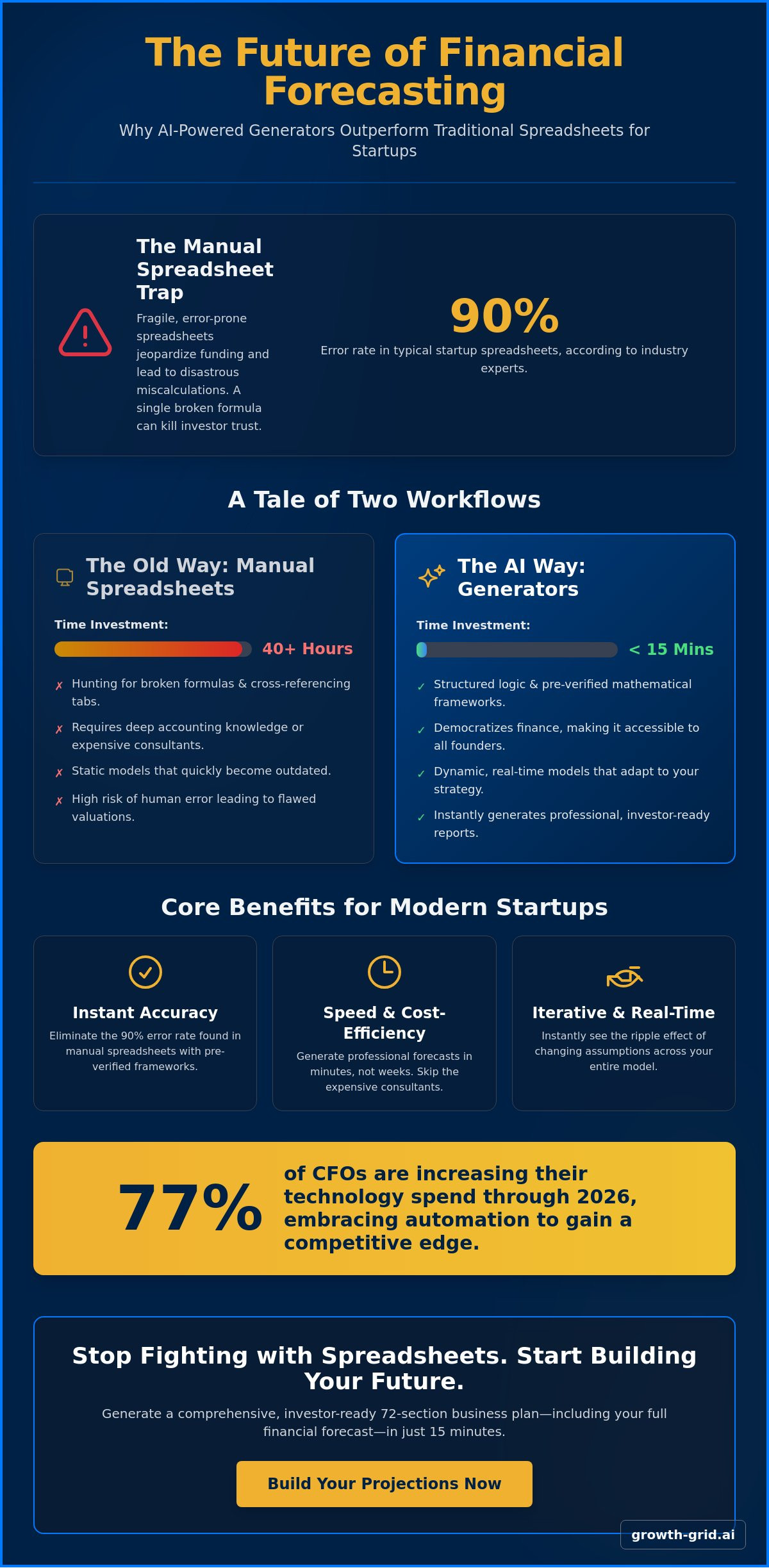
You don’t need a finance degree or an expensive consultant to build a professional forecast. Modern tools create investor-ready income statements in minutes. This shift toward automation is why 77% of CFOs are increasing their technology spend through 2026. You gain precision, speed, and the confidence to defend every assumption during your next pitch. It’s about replacing friction with a streamlined, professional workflow.
In this guide, you’ll learn how to master automated forecasting to secure funding and scale your startup with total clarity. We’ll show you how to move past the spreadsheet era and build a dynamic financial model that grows alongside your business.
Key Takeaways
- Stop wasting hours on manual spreadsheet errors that kill investor trust and lead to critical financial miscalculations.
- Master the five essential components of a professional forecast to explain your burn rate and revenue model with total confidence.
- Leverage an ai financial projection generator to turn raw data into a dynamic, strategic modeling engine that updates as your business scales.
- Bridge the gap between your marketing strategy and revenue growth to build a quantified narrative that secures funding from VCs and banks.
- Streamline your entire planning process by generating a comprehensive, investor-ready 72-section business plan in just 15 minutes.
The Evolution of Financial Forecasting: Why AI Generators Beat Spreadsheets
For decades, founders relied on fragile Excel files to predict their future. An ai financial projection generator changes that by acting as a high-speed strategic modeling engine rather than a simple calculator. It’s a fundamental shift in how startups quantify their potential. Instead of static numbers on a page, you get a living roadmap that adapts to your business decisions.
Manual spreadsheets are notorious for “The Legacy Problem.” Industry experts often find that up to 90% of manual startup spreadsheets contain critical formula errors. One broken link or a misplaced decimal can lead to a disastrous valuation or a premature cash out. AI eliminates these human-induced risks by using structured logic and pre-verified mathematical frameworks. Stop fighting with cells and start trust-testing your strategy.
Speed shouldn’t come at the cost of precision. Traditional forecasting takes weeks of manual labor and deep accounting knowledge. Modern platforms leverage Predictive Analytics to process industry benchmarks and historical data in seconds. This allows you to move from a static document to a dynamic, real-time model that actually reflects current market conditions. It’s about getting the right answers exactly when you need them.
AI vs. Traditional Financial Modeling
The “Old Way” involves 40+ hours of manual labor, hunting for broken formulas, and cross-referencing infinite tabs. It’s an exhausting process for anyone without a CPA background. The “AI Way” replaces this friction with structured logic. You can now reduce that massive workload to under 15 minutes. This democratizes finance for non-accountant founders. You don’t need a degree in finance to build a model that wins over VCs.
The Core Benefits for 2026 Startups
Professionalism is no longer tied to a $5,000 consultant fee. You can generate bank-grade reports that look like they came from a top-tier firm. Iterative planning becomes effortless too. Change one assumption, like your customer acquisition cost, and see the ripple effect across your entire income statement instantly. This builds massive confidence. You’ll present data-backed growth rates to investors instead of “finger-in-the-wind” guesses. If you’re ready to combine these financials with a full strategy, use an ai business plan tool to finish your pitch in record time.
- Instant Accuracy: Eliminate the 90% error rate found in manual spreadsheets.
- Cost Efficiency: Skip the expensive consultants and do it yourself in minutes.
- Real-Time Updates: Adjust your assumptions and see the results immediately.
Anatomy of a Professional Forecast: 5 Key Components Your AI Should Generate
A professional forecast is more than just a guess about next year’s sales. It’s a structured narrative of your business’s survival and growth. When you use an ai financial projection generator, the system builds this narrative across five critical pillars. This ensures you never walk into an investor meeting with a half-baked model. You need a system that translates your vision into a language banks and VCs actually speak.
Step 1: Establishing Your Revenue Logic
Your revenue model defines how your business actually survives. Are you a SaaS company with recurring subscriptions or a retail brand with one-time sales? You must define your unit economics and customer acquisition costs (CAC) clearly. AI-powered tools use cash flow analysis to project future earnings based on these specific drivers. This logic helps you differentiate between high-margin recurring revenue and volatile one-time transactions. It’s about building a model that reflects your real-world strategy.
Step 2: Mapping Expenses and COGS
Accurate forecasting requires a deep dive into your Cost of Goods Sold (COGS). For a product-based business, this includes materials and shipping. For service-based firms, it might include direct labor costs. Your model must also account for Operating Expenses (OpEx) like rent and software. A high-quality AI generator will automatically include SG&A (Selling, General, and Administrative) expenses. It should also calculate your hiring plans and payroll taxes without you needing to look up current tax brackets. This automation removes the risk of missing hidden costs that eat your margins.
Step 3: Generating the Three Core Statements
Investors look for the “Big Three” to verify your business’s viability.
- The Income Statement (P&L): This shows your profitability over a 3-5 year horizon. It’s the primary tool for measuring growth.
- The Balance Sheet: This tracks what you own (assets) versus what you owe (liabilities) and your equity. It proves your company’s net worth.
- The Cash Flow Statement: This is the most vital document. It visualizes exactly when money enters and leaves your bank account.
Remember that “profit” on an income statement doesn’t always mean you have cash in the bank. Understanding your burn rate and runway is critical for early-stage survival. Your burn rate tells you how much cash you lose each month. Your runway tells you how many months you have left before the bank account hits zero. If you want to see how these financials fit into a broader strategy, consider using an ai strategy document generator to align your goals with your budget and ensure every dollar spent drives your mission forward.
Overcoming the AI Hallucination Fear: Ensuring Accuracy and Realism
Can you really trust an AI to handle your company’s future? It’s the most common question founders ask. The fear of “hallucinated” numbers is real, especially when your reputation with investors is on the line. A professional ai financial projection generator doesn’t just guess. It operates within a strict mathematical framework designed to prevent illogical data spikes and impossible growth curves. You aren’t just getting a list of numbers. You’re getting a verified model built on accounting principles.
The accuracy of your forecast depends on the “Garbage In, Garbage Out” principle. If you provide vague data, you’ll get a vague result. High-quality systems use structured inputs to ensure every number has a logical origin. This isn’t a chatbot making up stories. It’s a strategic engine calculating outcomes based on the variables you provide. For example, if you input a specific customer acquisition cost, the AI calculates the ripple effect on your cash flow over the next 36 months.
Verification is the final step in building trust. You should always compare your AI-generated outputs against industry-standard benchmarks. If the generator predicts a 90% profit margin for a hardware startup, you know something is wrong. Reliable tools flag these unrealistic assumptions before you ever download the report. This keeps your pitch grounded in reality and saves you from embarrassing questions during due diligence.
Structured Inputs vs. Open Prompts
Don’t rely on a single, open-ended prompt from a generic chatbot. That’s a recipe for financial disaster. A professional tool uses a 72-section guided process to extract precise details about your business. This structured approach is much safer than a “one-click” solution. The AI asks clarifying questions to refine the model, identifying contradictions in your data before they become errors. It ensures that your revenue growth aligns with your hiring plans and marketing spend. If your projected sales require 50 employees but your payroll only accounts for five, the system will alert you to the discrepancy.
The Human-in-the-Loop Advantage
Think of AI as your high-speed first draft. It does the heavy lifting, but you provide the essential market context. You must refine the output with your specific local knowledge or niche expertise. Cross-reference these projections with your startup business plan to ensure total alignment between your goals and your budget. The most critical part of any financial report is the “Key Assumptions” section. Review this carefully. When you understand the logic behind every number, you can defend your financials with total confidence during any pitch.
Strategic Implementation: Using AI Projections to Secure Funding
Generating the numbers is only half the battle. You must now use your ai financial projection generator output to close the deal. Investors don’t just look at the bottom line. They look for the “story” that connects your marketing plan to your revenue growth. If you claim a 50% month-over-month increase, you must show the specific marketing spend that drives it. Clarity wins pitches. Speed builds trust. Professionalism secures the check.
Don’t present a single path. Smart founders show “Best Case,” “Worst Case,” and “Expected” projections. This demonstrates that you’ve considered market volatility. It shows you aren’t just guessing; you’re planning. Use these financials as a management tool. They aren’t just for fundraising. They’re your internal dashboard for measuring actual performance against your goals. When you know your numbers, you lead with authority.
Investor Readiness Checklist
Consistency is your most valuable asset during due diligence. Your Year 1 monthly detail must match your operational reality exactly. If you plan to hire three developers in Q2, your payroll taxes must reflect that. Ensure there is total alignment between your business plan and your financials. Prepare to defend your “Key Assumptions” section. Investors will poke holes in your logic. Be ready to explain the data behind your customer acquisition costs and churn rates.
Scenario Planning for Scalability
Use the AI to model the impact of a 20% increase in marketing spend. Does it shorten your path to profitability, or does it burn through your cash too fast? You need to identify your “Break-Even” point with precision. This is the moment your business becomes self-sustaining and stops relying on outside capital. Also, model the “Cost of Delay.” What happens to your runway if the product launch takes 3 months longer than expected? Knowing these answers before the meeting makes you the most prepared person in the room.
Stop guessing and start modeling. You can build your investor-ready model today and walk into your next meeting with total confidence. It is time to replace your outdated spreadsheets with a dynamic strategy that actually works.
Generate Your 72-Section Business Plan and Financials with GrowthGrid
Traditional business planning is a relic of the past. Why spend $5,000 on a consultant or waste 40 hours on a spreadsheet that might still contain errors? GrowthGrid is the fastest ai business plan generator on the market. It’s built for founders who value speed and precision. You can move from a rough idea to a comprehensive, investor-ready document in just 15 minutes. This efficiency represents a 98% cost saving compared to legacy methods. Stop waiting for perfection and start generating results.
Most tools treat your financials as an isolated data point. GrowthGrid is different. Our ai financial projection generator is part of a cohesive ecosystem. It integrates your revenue models directly with your strategy, HR, and legal documentation. This ensures your entire business narrative is synchronized. When you change a hiring goal in your HR section, your payroll projections update automatically. It is a complete, future-forward solution for the modern entrepreneur.
The GrowthGrid Ecosystem
Our platform links your market analysis directly to your revenue projections. This prevents the “logic gap” that often kills startup deals. You get 72 sections of professional, expert-vetted content that covers every angle of your operation. Once finished, your plan is available in high-quality PDF or DOC formats. These are ready for immediate distribution to VCs, angel investors, or banks. You aren’t just getting a template. You’re getting a quantified roadmap for success.
- Total Integration: Financials, HR, legal, and strategy documents in one place.
- Expert Quality: 72 sections of structured, professional content.
- Investor Ready: Clean, downloadable formats designed for immediate use.
Start Your 15-Minute Journey Today
You don’t need an accounting degree or a background in finance to build a world-class model. GrowthGrid uses a simple, question-based interface that guides you through the process. It’s designed to be intuitive and stress-free. Our pricing is transparent and affordable, scaling alongside your startup’s needs. You get professional-grade output without the professional-grade overhead. It’s time to take control of your company’s narrative and secure the funding you deserve.
The days of manual formulas and broken links are over. Empower your business with a platform that works as hard as you do. Build your investor-ready financial projections now and experience the future of strategic planning.
Secure Your Funding with Data-Backed Precision
Stop letting manual spreadsheet errors jeopardize your startup’s future. You now understand how an ai financial projection generator transforms complex accounting into a strategic advantage. By focusing on the five core components of a professional forecast and using structured AI frameworks, you eliminate the risk of “hallucinated” numbers and build trust with investors. Financial clarity is the foundation of every successful pitch.
It’s time to move from static documents to a dynamic modeling engine. GrowthGrid is already used by thousands of startups globally to create comprehensive, investor-ready documents. Our platform provides a 72-section output that is 98% cheaper than hiring traditional consultants. You’ll achieve professional-grade results without the high overhead or weeks of manual labor. Efficiency is the new standard for modern founders.
Generate Your 72-Section Business Plan & Financials in 15 Minutes. Your business strategy deserves a quantified narrative that reflects your true potential. Take the first step toward scaling your vision with total clarity and speed. You have the tools; now it’s time to build your future.
Frequently Asked Questions
Is an AI financial projection generator accurate enough for banks?
Yes, an ai financial projection generator is accurate enough for banks when it follows standard GAAP principles. Lenders require a clear Income Statement, Balance Sheet, and Cash Flow Statement to assess risk. Because these tools use structured mathematical frameworks, they eliminate the manual formula errors that often lead to loan rejections. You receive a professional, bank-grade report that demonstrates your fiscal responsibility and repayment capacity.
What data do I need to provide to generate a financial forecast?
You must provide your core unit economics, customer acquisition costs (CAC), and planned operating expenses. Include specific details about your hiring roadmap and any necessary equipment or inventory. The more precise your inputs regarding fixed and variable costs, the more realistic your final forecast will be. High-quality generators guide you through these categories to ensure no critical expense is overlooked during the process.
Can I export my AI-generated financials to Excel or PDF?
Most professional platforms allow you to export your completed financials in PDF or DOC formats for immediate investor distribution. These formats are preferred by VCs and banks because they maintain the structural integrity of your reports. Providing a polished, non-editable document ensures your data remains consistent during due diligence. It also prevents accidental formula breaks by third parties who might otherwise alter your strategic model.
How many years of projections should my business plan include?
Your business plan should typically include three to five years of financial projections. The first year must be detailed on a month-by-month basis to show your immediate operational viability and burn rate. Years two through five are generally presented as annual summaries. This specific timeframe allows investors to see your long-term growth trajectory and identify the exact point where your business becomes self-sustaining.
Does the AI account for taxes and regional financial regulations?
Modern AI tools typically automate payroll taxes and standard corporate tax calculations based on current logic. However, you should always verify these figures against your specific local requirements. As of May 2026, the regulatory landscape is evolving with state-level laws like the Colorado AI Act impacting financial services. Always review the “Key Assumptions” section of your generated report to ensure your model aligns with regional compliance standards.
How do I handle ‘hallucinations’ or unrealistic numbers in the AI output?
You handle unrealistic numbers by using a structured, section-by-section input process instead of open-ended prompts. If the output seems skewed, review your initial data for “Garbage In, Garbage Out” errors. Compare your projected margins against industry benchmarks for your specific sector. Professional tools include internal flags that alert you when growth curves or profit margins deviate significantly from established market standards.
What is the difference between an income statement and a cash flow projection?
An income statement measures your profitability over time, while a cash flow projection tracks the actual timing of money entering and leaving your bank account. You can be profitable on paper but still run out of cash if your customers pay slowly. The ai financial projection generator creates both documents to show you not just what you earn, but exactly when you can afford to pay your bills.
Can I update my projections as my business grows?
You can and should update your projections as your business scales and market conditions change. Treat your financial model as a living document rather than a one-time requirement for funding. By adjusting your assumptions based on real-world performance data, you turn your forecast into a powerful management tool. This allows you to pivot your strategy quickly and maintain an accurate, real-time view of your future runway.