

Your business entity choice isn’t just a legal formality; it’s the strategic architecture that determines if your venture survives its first year or collapses under personal liability. Most entrepreneurs spend months paralyzed by the fear of choosing the wrong legal structure for small business plan filings, worried they’ll lose their savings or get crushed by unexpected tax bills. It’s exhausting to feel like you need an expensive consultant just to decide between an LLC and a Corporation.
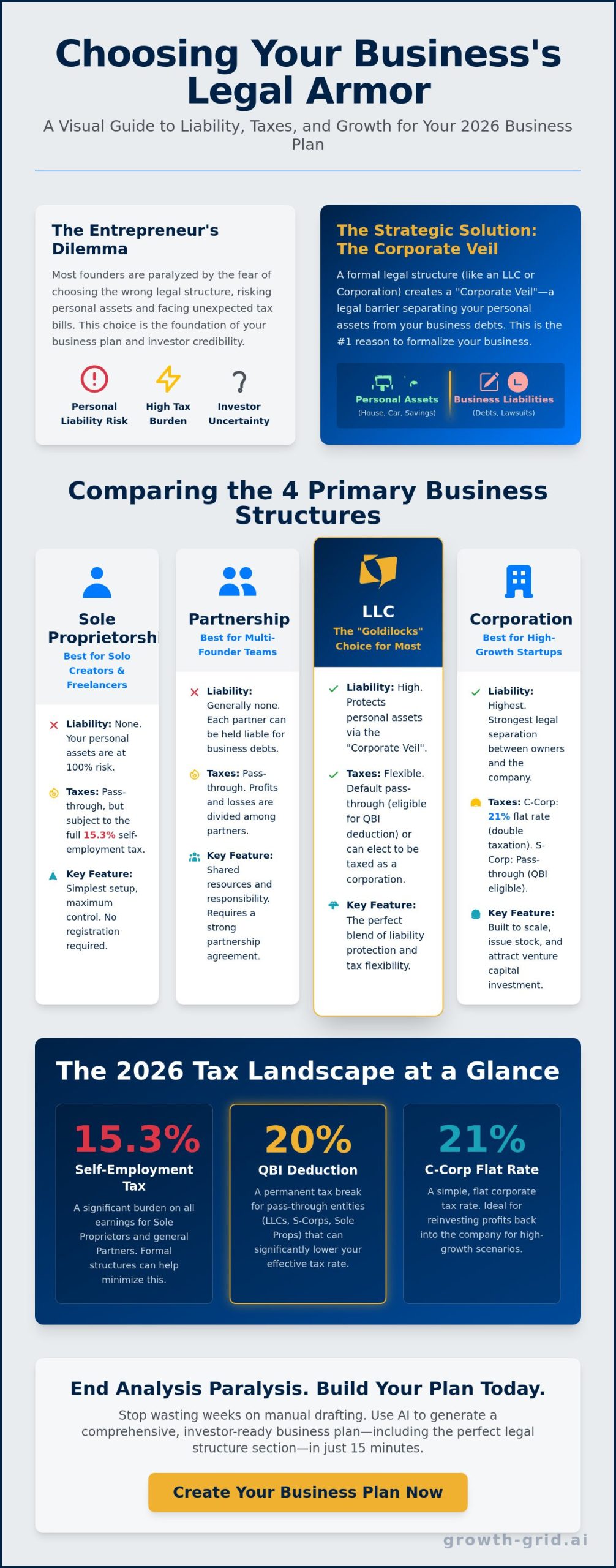
We’re here to end the analysis paralysis and help you move forward with confidence. You can master your legal foundations today to protect your assets and scale your operations faster. This guide provides total clarity on the 2026 tax landscape, including the flat 21% C-Corp rate and the permanent 20% QBI deduction for pass-through entities. You’ll learn exactly how to minimize your 15.3% self-employment tax burden and build a professional legal section that makes your business plan investor-ready. Let’s create a structure that secures your future and maximizes your profit.
Key Takeaways
- Understand why investors and banks prioritize your legal organization to assess risk and determine funding eligibility.
- Identify the optimal legal structure for small business plan success by comparing liability protection and tax efficiency across different entities.
- Navigate 2026 tax standards with ease, including the 21% C-Corp flat rate and permanent QBI deductions for pass-through entities.
- Master the exact documentation requirements for your “Company Summary” to ensure your ownership percentages and EIN status look professional.
- Eliminate weeks of manual drafting by using AI tools to generate a comprehensive, 72-section business plan in just 15 minutes.
Why Legal Structure is the Backbone of Your Business Plan
Your business plan is more than a pitch deck; it’s a blueprint for survival. At its core lies the legal structure, which is the formal organization of your business recognized by government and tax authorities. Think of it as your company’s DNA. It dictates how you’re taxed, who’s in charge, and how much of your personal life is at risk if things go sideways. You aren’t just filing paperwork; you’re setting the rules for how your business interacts with the world.
Investors and banks don’t start with your marketing strategy. They look at your entity choice first to assess risk. A vague or improper choice of legal business structures signals amateurism. If you haven’t decided how the business is organized, you haven’t decided how it will scale. Getting this wrong is expensive. Re-filing fees can range from $50 in states like Colorado to over $300 in Massachusetts. The real cost, however, is the tax penalty. Choosing the wrong legal structure for small business plan goals could leave you stuck paying a 15.3% self-employment tax on all earnings when a corporate structure might have shielded a portion of that income.
The Link Between Structure and Credibility
A formal structure tells the world you’re a professional entity, not a weekend hobbyist. When you’re drafting a startup business plan, your entity choice is your first handshake with potential partners. Suffixes like “LLC” or “Inc.” carry psychological weight. They tell vendors you have a registered identity and tell lenders you’re serious about compliance. Without this, your plan is just a list of ideas. With it, it’s a legitimate commercial roadmap that partners can trust.
Asset Protection and Risk Management
The primary reason to move beyond a sole proprietorship is the “Corporate Veil.” This legal concept creates a wall between your personal bank account and your business debts. If your business faces a lawsuit, that veil ensures your house, car, and personal savings aren’t on the line. Your business plan must explicitly state how your chosen structure mitigates operational risks. It shows you’ve thought about the worst-case scenario and built a fortress to protect your future.
Consider this standard for your plan: “Our business is organized as a Limited Liability Company (LLC) to provide a robust legal barrier that protects the owners’ personal assets from company-specific liabilities and debts.” This single sentence provides the security investors need to see. Don’t leave your personal wealth to chance. Choose a structure that shields you while you grow.
Comparing the 4 Primary Structures for Small Businesses
Selecting the right legal structure for small business plan documentation is a high-stakes decision. You aren’t just picking a label. You’re choosing your tax rate, your liability level, and your ability to attract capital. Most entrepreneurs fall into one of four categories. Each has distinct trade-offs regarding speed and protection. You must decide which architecture supports your 2026 growth goals.
- Sole Proprietorship: This is the default setting for solo creators. It’s the simplest way to start. It offers maximum control but zero liability protection. You and the business are legally the same person.
- Partnership: Ideal for multi-founder teams. It allows for shared resources and responsibility. However, it requires a rock-solid agreement to prevent future legal drama between partners.
- Limited Liability Company (LLC): This is the “Goldilocks” choice for most. It provides the asset protection of a corporation with the tax flexibility of a partnership.
- Corporation (C-Corp or S-Corp): The standard for high-growth startups. It’s built for scale, issuing stock, and attracting institutional investment.
While most focus on these four, niche plans might require a Cooperative or a Non-profit structure. These are specialized models for member-owned organizations or social missions. If you’re unsure where you fit, you should Choose a Business Structure based on your long-term scaling goals rather than short-term convenience.
LLC vs. Sole Proprietorship: The 2026 Reality
In 2026, the digital-first economy heavily favors the LLC. The setup is nearly instantaneous. Legacy methods used to take weeks of manual filing and mailing. Now, you can often secure your entity in under 15 minutes. The “pass-through” tax benefit is the real winner here. Your business profits aren’t taxed at the entity level. Instead, they “pass through” to your personal income tax return. This avoids the double taxation trap while keeping your personal assets safe from business creditors. It’s a professional shield for a modern founder.
When to Choose a Corporation
Institutional investors rarely look at LLCs. If your business plan includes raising venture capital, a C-Corp is usually mandatory. It provides a clean structure for issuing stock and managing complex ownership. This comes with a heavier administrative burden. You’ll need to hold formal board meetings, record minutes, and maintain strict bylaws. If the 21% flat corporate tax rate feels like a hurdle, you can elect S-Corp status. This allows you to pay yourself a reasonable salary and take dividends. This move can significantly reduce your 15.3% self-employment tax bill as your revenue grows. To get these details right without the headache, you can generate your legal strategy documents using specialized AI tools to ensure your plan looks investor-ready.
5 Critical Factors for Choosing Your Business Entity
Stop guessing and start calculating. Your legal structure for small business plan development isn’t a one-size-fits-all choice. It’s a strategic calculation based on your risk, tax goals, and exit plan. You need a weighted decision framework to ensure your foundation is solid. Five critical factors will determine your success and protect your bottom line in 2026.
- Liability Protection: Determine how much personal risk you can tolerate. If your business is sued, can you afford to lose your home or personal savings?
- Taxation Strategy: Compare the 21% flat C-Corp rate against the pass-through benefits of an LLC. Every dollar saved on taxes is a dollar reinvested in growth.
- Capital Needs: Are you bootstrapping or seeking outside investment? If you’re performing a cash flow analysis that relies on venture capital, institutional investors will demand a C-Corp structure.
- Operational Complexity: Be honest about your administrative capacity. Can you handle the annual reporting, board meetings, and formal minutes required by a corporation?
- Exit Strategy: Think five years ahead. Do you plan to sell the business, pass it to heirs, or go public? A clean structure makes the due diligence process faster and more profitable for buyers.
Evaluating Your Risk Profile
High-risk industries like construction, food service, or manufacturing face constant litigation threats. Even if you’re in a low-risk field like consulting, professional errors can lead to massive claims. Don’t fall for the myth that liability insurance replaces a legal structure. Insurance has limits, exclusions, and deductibles. A proper entity provides a secondary, permanent wall. The SBA guide to business structures emphasizes that your choice must align with your industry’s specific exposure. Our choice of an LLC provides a shield for personal assets against business-related lawsuits.
Scaling and Future-Proofing Your Plan
Converting your business structure later is a logistical nightmare. It involves high legal fees and potential tax hits on asset transfers. Your business plan should forecast entity changes as your revenue hits specific milestones. For example, you might start as an LLC but plan to elect S-Corp status once your profits exceed $100,000 to save on the 15.3% self-employment tax. This proactive approach avoids the “Complexity Tax” of running a heavy administrative structure before you have the revenue to support it. Make a decision that fits your current reality while leaving the door open for 2026 and beyond.
How to Document Your Legal Structure in a Professional Plan
Don’t bury your legal details in an appendix where they’ll be ignored. Your legal structure for small business plan documentation belongs in the “Company Summary” or “Legal/Management” chapter. This is the section where lenders and partners look to verify your commercial identity. If this section is vague, your entire plan loses credibility. You must present these facts with the same precision you use for your financial projections.
Include your specific state of incorporation and your Employer Identification Number (EIN) status. If you’re filing in California, for instance, your plan should acknowledge the $70 Articles of Organization fee and the $800 annual franchise tax. This level of detail proves you’ve researched the cost of doing business in 2026. If you haven’t received your EIN yet, simply state that it’s “pending upon entity approval.” This shows you’re proactive and understand the sequence of business formation.
Drafting the Legal Summary Section
Use a concise, three-sentence template to describe your entity. First, name the business and its legal form. Second, state the jurisdiction of registration. Third, highlight the primary liability or tax benefit. For example: “[Business Name] is a Limited Liability Company registered in Florida. This structure provides a robust legal barrier between company debts and the owners’ personal assets. We’ve appointed a Registered Agent at [Physical Address] to manage all state compliance notices.”
Consistency across your documents is vital for passing due diligence. If you used an ai business plan generator, ensure the legal entity name matches your strategy and HR documents exactly. Any discrepancy in your company name or structure across different sections is a red flag for banks. It suggests a lack of attention to detail that could lead to future legal friction.
Ownership and Equity Breakdown
List every founder, stockholder, or member with their exact ownership percentage. If you’re a multi-person startup, you must address your vesting schedules here. This tells investors that the management team is committed to long-term growth rather than a quick exit. Clearly define who has voting rights and who holds silent equity. This transparency prevents internal disputes and shows you’ve built a professional governance model.
Mention your supporting documents like Operating Agreements or Bylaws. You don’t need to paste a 40-page legal document into your business plan. Just state that these documents are finalized and available for review in your records. This simple mention signals to partners that you’ve moved beyond handshake deals and have a formal framework for conflict resolution. Ready to finalize your documentation? Generate your professional business plan in minutes and ensure your legal section is investor-ready.
Launching Faster: Automating Your Business and Legal Planning
The traditional path to finalizing a legal structure for small business plan documentation is a notorious bottleneck. This “Legacy Method” usually involves weeks of manual research and expensive hourly consultations. It drains your startup capital before you even make your first sale. In 2026, speed is the ultimate competitive advantage. You can’t afford to let administrative friction stall your launch while competitors move at the speed of AI.
The “GrowthGrid Method” replaces this outdated workflow with a streamlined, results-oriented process. Instead of staring at a blank page, you use intelligent automation to build your foundation. Our AI Business Plan Generator creates a comprehensive, 72-section plan that includes your legal framework in just 15 minutes. This isn’t just a template. It’s a customized strategic document that aligns your entity choice with your specific industry risks and 2026 tax obligations.
Legacy Method: Weeks of drafting, thousands in overhead, and manual errors.
GrowthGrid Method: 15-minute generation, professional-grade accuracy, and instant scalability.
From Idea to Professional Plan in 15 Minutes
Our system handles the “Legal Structure” section automatically based on your stated goals. If you’re seeking venture capital, the AI prioritizes C-Corp requirements. If you’re bootstrapping, it optimizes for LLC pass-through benefits. Most importantly, it ensures your financial projections align perfectly with your tax structure. You receive your plan in a DOC format. This allows for easy legal review later without the need to retype or reformat your entire strategy. It’s about creating high-value results with minimal effort.
Ongoing Legal Support for Small Businesses
A professional legal structure for small business plan filings is just the beginning. Once your entity is established, you need the operational documents that keep you compliant. Our AI Legal Document Generator and AI HR Document Generator provide immediate access to essential paperwork. You can generate NDAs, employment contracts, and privacy policies instantly. This removes the “Complexity Tax” that often slows down new founders. You get the protection of a large corporation at the speed of a lean startup.
Don’t let analysis paralysis or high overhead stop your progress. You have the tools to build a secure, scalable, and professional business foundation today. Take control of your company’s future and move from concept to compliance in record time. Generate your professional business plan and legal documents now and start building with confidence.
Build a Future-Proof Business in Minutes
Your vision deserves a foundation that protects your hard work and maximizes your profit. You now have the roadmap to navigate the 2026 tax landscape and separate your personal assets from business risks. A clear legal structure for small business plan documentation is the signal investors and lenders need to see. It transforms a simple idea into a professional, bankable entity. Don’t let the fear of paperwork or high overhead stall your progress any longer.
You can eliminate weeks of administrative friction today. Our platform is trusted by startups worldwide to generate 72-section comprehensive AI business plans and instant legal or HR documents. Stop overthinking the process and start executing your strategy with confidence. You have the tools to launch faster, protect your wealth, and scale without limits. It’s time to move from the legacy era of planning into a streamlined, results-oriented future.
Create your professional business plan in 15 minutes
The modern economy rewards the efficient. Take the first step toward a secure and successful launch right now. You’re ready to build something great.
Frequently Asked Questions
What is the best legal structure for a one-person small business?
An LLC is typically the best choice for a solo founder because it balances simplicity with protection. It separates your personal assets from business liabilities while allowing profits to pass through to your personal tax return. This avoids the double taxation found in C-Corporations. You get a professional suffix that builds immediate trust with your vendors and clients.
Do I need a lawyer to choose my business structure for my plan?
You don’t necessarily need a lawyer to select a legal structure for small business plan documentation. Most entrepreneurs use government resources or automated AI tools to handle the drafting process. While a lawyer provides personalized advice, modern technology can generate professional-grade legal sections and documents in minutes. Always verify your specific state requirements before finalizing your choice.
How does my business structure affect my taxes in 2026?
Your structure determines if you pay the flat 21% corporate tax rate or the individual income tax rate. Pass-through entities like LLCs are subject to a 15.3% self-employment tax on earnings up to the $184,500 Social Security wage base. You can still leverage the permanent 20% Qualified Business Income (QBI) deduction to lower your overall tax burden in 2026.
Can I change my business structure after I finish my business plan?
You can change your structure, but it’s an expensive and time-consuming process. It often requires new Articles of Incorporation, updated EINs, and significant re-filing fees that range from $50 to over $300 depending on your state. It’s much more efficient to forecast your growth and select a structure that scales with your revenue milestones from day one.
What is an EIN and do I need one for my business plan?
An EIN is an Employer Identification Number, which acts as a Social Security number for your business. You absolutely need one to open a business bank account, hire employees, or file taxes. Your business plan should state your EIN status to show lenders you’ve completed the necessary federal registrations to operate as a legitimate entity.
Is an LLC or an S-Corp better for a startup seeking investors?
A C-Corporation is the gold standard for startups seeking venture capital or institutional investors. It allows for multiple classes of stock and clear equity distributions that investors prefer. While an LLC or S-Corp is great for bootstrapping, most high-growth startups eventually convert to a C-Corp to handle the complexity of large-scale funding rounds.
What legal documents should I attach to my business plan?
You should include your Articles of Organization, an Operating Agreement, and your EIN confirmation as supporting documents. If you’re a corporation, include your Bylaws and a summary of your cap table. These documents prove that your chosen legal structure for small business plan filings is backed by formal governance. They provide the transparency that banks and partners demand.
How much does it cost to set up a legal structure for a small business?
Costs vary significantly by state, ranging from $50 in Kentucky or Colorado to over $300 in Massachusetts. If you’re in California, expect to pay a $70 filing fee plus a minimum $800 annual franchise tax. Most entrepreneurs spend between $500 and $1,000 in total to cover state fees, registered agent services, and the initial documentation required to launch properly.